UK money
Kakeibo in the UK
Council tax, the weekly shop, energy and travel, sorted into the four envelopes in the words a UK household actually uses. No conversion, no rule borrowed from another country's income.
Kakeibo does not need adapting for the UK the way it needs adapting for a credit card or a five payday month. The method is four categories and a monthly reflection, and a pound sorts into Survival, Optional, Culture or Extra exactly the way a dollar does. What changes between countries is not the arithmetic. It is which bills actually land in each envelope, and a UK household's bills are not quite the same list an American or an Australian one works from.
The four envelopes, in UK money words
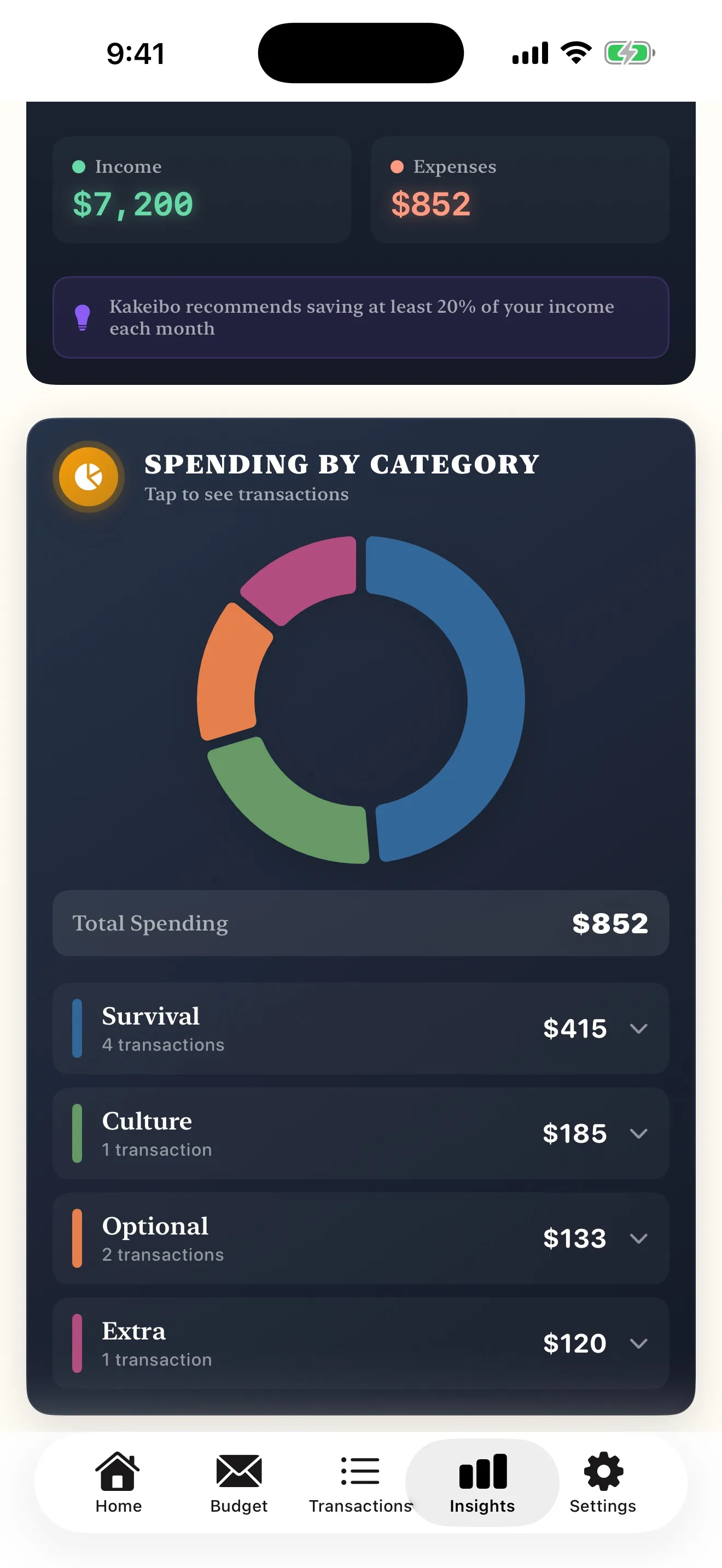
Survival is rent or the mortgage, the weekly shop, energy, council tax and travel to work. Every one of those arrives whether the month is going well or not, which is the only test Survival ever uses. Optional is takeaways, subscriptions and the shopping you would not actually miss if it stopped. Culture is a course, a museum membership, books, the spending that improves you rather than just passing the time. Extra is car repairs, a wedding gift, the vet, the costs that are real but do not arrive every month. The full argument for where the awkward cases sit, a gym membership, a subscription that genuinely gets used, is worked through in the four categories guide; this page only needs the UK specific list.
Two lines on that list are worth a second look because UK pages on this topic often get them wrong. Council tax is not rent and it is not a utility, but it is billed on a schedule regardless of what else happened that month, so it belongs in Survival with everything else that passes that test. And the weekly shop is Survival only for the food that keeps the household fed; a takeaway or a delivery bought instead of cooking is a choice made in a moment that could have gone differently, which is Optional, not Survival.
What the Office for National Statistics actually publishes
The UK Office for National Statistics runs the Family Spending release, and its bulletin for the year to March 2025 put average weekly household expenditure at 676.60 pounds. Housing, net, fuel and power accounted for 118.40 pounds of that, 18 percent. Read that category carefully before comparing it to your own rent or mortgage: it excludes mortgage interest payments and council tax, which the survey books under separate headings entirely, so a homeowner's true housing share runs higher than the published 18 percent on its own. Transport took 96.40 pounds, 14 percent of the average total, a category that covers running a car as well as buying one.
The same release does not hand over a clean total for food. It reports a rise in food spending, 3.20 pounds nominal and 1.60 pounds real against the previous year, rather than a share of the average total. That gap is the ONS's own caution about the year's sample rather than this site declining to look hard enough, and it is worth knowing before searching for a figure that the bulletin does not, in fact, contain.
None of those figures describe your household. They describe the average one the survey sampled, which is why the next section works a real example rather than treating 18 percent as a target to hit.
Council tax, and the ten month pattern
Most councils in England and Wales spread the annual council tax charge over ten monthly instalments running from April to January, leaving February and March clear of a payment. Scotland generally runs the same ten month pattern; a handful of councils offer twelve month billing on request. Whichever your own council uses, the figure that belongs in a kakeibo ledger is the instalment you are actually billed that month, not the annual total divided evenly by twelve, because a Survival envelope sized on the wrong monthly figure either comes up short eight months a year or sits on money that was never going to be needed in February.
The two clear months are not a windfall. They are the one month in ten when council tax is zero and Survival's total genuinely drops, which is worth noticing at the monthly reflection rather than letting it quietly inflate Optional for two months before the instalments start again in April.
Pay day, monthly or otherwise
Most UK salaries are paid monthly, which lines up neatly with the calendar month kakeibo already runs on. Where pay arrives four weekly instead, the same household gets thirteen paydays a year rather than twelve, so one calendar month in most years contains two. That extra payday is not a raise and it is not Optional's to spend; it is a decision for the savings promise or for Extra, made once a year rather than rediscovered as a pleasant surprise every time it happens.
One household, worked through
Take a household with 2,400 pounds a month in take home pay. Rent runs 850, the weekly shop averages 220 a month, energy comes to 140, council tax in an instalment month is 160, and travel to work is 90. Survival totals 1,460, leaving 940 to cover everything else. A reasonable split there runs 350 to the savings promise, 300 to Optional, 140 to Culture and 150 to Extra. In February or March, with council tax at zero, Survival drops to 1,300 and the extra 160 becomes a real decision rather than money that quietly vanishes into whichever envelope spent it first.
Running this on your own numbers rather than reading someone else's is the point. The four category split calculator does the division on your actual income and your actual Survival total, council tax instalment months included, rather than assuming the UK average fits your household. The savings rate calculator turns whatever reaches the savings promise into a percentage of take home pay, which is the number worth tracking month to month far more than the pound figure on its own.
Where the plan goes next
A savings promise needs a target with a date attached to it, not just a direction. 5,000 pounds in 12 months already carries that figure through to its monthly, weekly and daily number, in pounds rather than converted from a dollar page, and the same page lays out which envelope the monthly figure is realistic to expect it from. A household whose own total or deadline is different is better served running the kakeibo savings goal calculator on the real number than scaling a worked example by hand.
Nothing here sits outside the kakeibo method itself. The four envelopes and the monthly reflection are the whole method wherever they are run; this page is only the UK translation of which bills go where, named precisely enough to check against your own.
Common questions
- Does kakeibo work with UK money?
- Yes, and nothing about the method needs converting. Kakeibo is four categories and a monthly reflection, not a currency. Rent or the mortgage, the weekly shop, energy and council tax sort into Survival the same way they would in any household; what changes between countries is only which bills sit in that envelope.
- What share of UK household spending goes on housing?
- The UK Office for National Statistics Family Spending release for the year to March 2025 put housing, net, fuel and power at 18 percent of average weekly household expenditure, 118.40 pounds of a 676.60 pound average. That category excludes mortgage interest and council tax, which the survey books separately, so a homeowner’s true housing share runs higher than 18 percent on its own.
- Does council tax go in Survival?
- Yes. It is billed whether or not the month goes well, which is the test Survival uses for everything else in it, the same test that puts rent and energy there. Most councils in England and Wales spread the annual charge over ten monthly instalments, April to January, with February and March left clear, so the monthly figure in the ledger is not simply the annual total divided by twelve.
- What if I am paid four weekly instead of monthly?
- Budget against the calendar month kakeibo actually runs on, not against whichever payday happens to land in it. A four weekly wage packet produces thirteen paydays a year rather than twelve, so one calendar month in most years carries two, and that month’s surplus belongs to the savings promise or to Extra, not to Optional, because it is not a raise.
- Where can I find a UK savings target in pounds?
- The site’s savings target pages run in pounds as well as dollars, so a target such as 5,000 pounds in 12 months already has its own monthly, weekly and daily figure worked out rather than a conversion from a dollar page.
- Is this the same as the 50/30/20 rule?
- No, and the two are compared properly on a separate page rather than here. The short version: 50/30/20 names three budget lines by a fixed share of income, where kakeibo names four by what the spending is for and lets the shares move with the household.
The same four envelopes. UK bills, UK pay days.
Council tax, the weekly shop, energy and travel sort into Survival the way they would anywhere else. What a UK household actually needs is the right monthly figure for each one, not a rule imported from a different income.