The smallest version
Kakeibo with ADHD
The method asks for one thing every day: write down the amount. For some people that one thing is exactly the part that does not survive a hard day, no matter how much they want it to. Here is the version of kakeibo built to still work on those days.
- Published
- 22 October 2026
- Written by
- The Kakeibo Method team
- Reading
- 8 minutes
- Filed under
- When the month is difficult
Kakeibo asks for one thing every day: write down what you spent, close to the moment you spent it. Most advice about the method treats that as the easy part, a thirty second habit sitting underneath the real work of sorting and reflecting. For some people the daily entry is the part that does not hold, and it is not for lack of wanting it to. A hard day eats the one task that needed the least left in the tank, and a method that depends on that task every single day is a method that keeps failing for a reason that has nothing to do with the money.
None of what follows is a clinical claim about why recording is harder on some days than others, and this page will not guess at one. What it will do is treat the problem as what it actually is in front of the ledger: friction in a specific, nameable place, with a specific repair. The method does not need a diagnosis to be adjusted. It needs the version of itself that still gets written down.
The smallest version that still works
Kakeibo has three moving parts: record the amount, sort it into one of four categories, and read the month back at the end of it. All three matter eventually, but they do not have to happen at the same moment, and bolting them together is what makes the daily entry heavier than it needs to be.
The smallest working version keeps exactly one of the three in the moment of spending: the amount. Nothing else. Not Survival, Optional, Culture or Extra, not a note about what it was for beyond what the receipt already says, just a number against a date. That single number is the whole daily task, and a task that small survives days the three part version does not.
Sorting into the four envelopes happens later, in one sitting, against the list of amounts the week produced. The four categories guide sets out what belongs where, and none of that thinking is better done in the thirty seconds after a purchase than it is in a calmer ten minutes once a week. Separating the two tasks does not skip a step the method needs. It moves the step to a moment that can actually hold it.
Where the friction actually sits
Three places account for most of where this habit stalls, and none of them is the arithmetic.
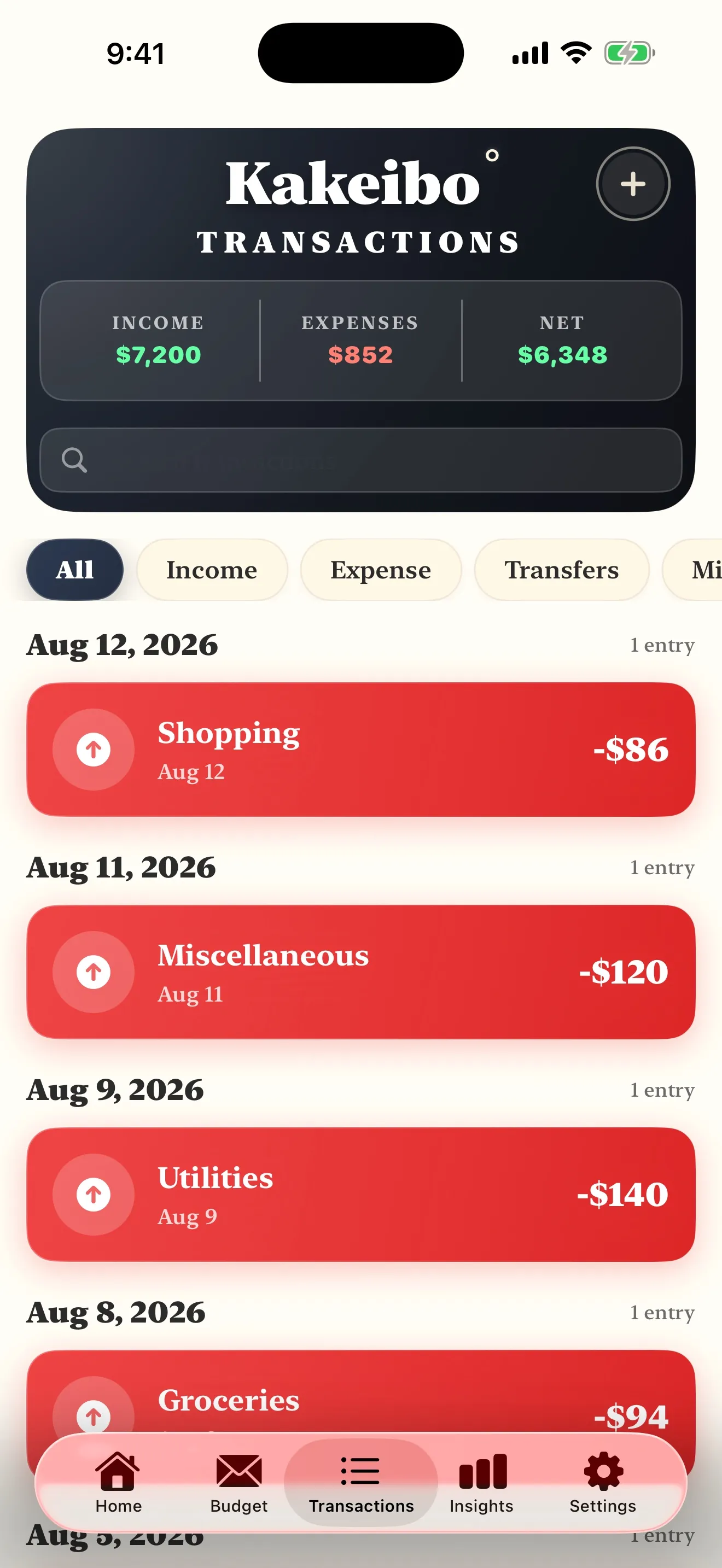
The tool is not already in your hand. A notebook left on the kitchen table records nothing from the supermarket, and a login screen between you and the entry is one decision too many on a day that only had room for one. Whatever holds the ledger has to be the thing you are already holding when the spending happens, which for most people now is a phone rather than a dedicated notebook, not because paper is wrong but because paper that is not on you is not available.
Sorting is bolted onto recording. Being asked to decide a category at the counter adds a second decision to a task that was supposed to need none, and a second decision is often the one that gets the whole entry postponed to later, which is exactly the moment it stops happening at all.
A gap starts to feel too large to open. Two missed days start to look like a backlog rather than two numbers, and a backlog reads as a project rather than a thirty second task, so it keeps getting put off in favour of something that feels more finishable. The size of the actual task never changes. The feeling of it does, and that feeling is doing the damage.
Remove the friction, not the structure
The repair for each of those is specific, and none of it asks for more willpower.
- Put the ledger where the spending happens. If that is a phone, a one tap entry screen with no login step beats a more thorough tool that is one screen further away. The safe to spend calculator is also worth keeping close, since checking a single number before a purchase you are unsure about is a smaller task than deciding a category would have been, and it still does real work.
- Record the amount only, every time, no exceptions.Make the category decision a once a week task done away from the counter, with last week's list in front of you and nothing else competing for the moment. If paper genuinely suits you better than a screen, a ruled page kept in the one bag or pocket you use daily works the same way. What a notebook left in a drawer at home does not do is show up on the days that matter.
- Treat a gap as one line, not a reconstruction.A missed day or three is a single bank total added honestly against the right dates, not a project to rebuild receipt by receipt. The moment reconstruction starts to feel like the price of catching up, most people choose not to pay it and stop instead. Paying nothing and adding one line costs the method far less.
Each of these removes a step rather than adding one. That distinction matters, because a method that keeps getting more structure bolted onto it to solve a friction problem usually ends up with more friction, not less.
The reflection still earns its place
The monthly reflection asks four questions about the month just finished, and it is reasonable to assume a patchy daily habit means a reflection with nothing solid to work from. In practice the reflection needs far less than a perfectly kept ledger. A week folded into a single bank total still has a real number in it. A month built from four such weeks, plus the days that were recorded properly, still totals to something true about where the money went, even if it cannot say which exact Tuesday it went on.
What actually breaks the reflection is not imperfect daily entries, it is no entries at all for stretches long enough that even a bank total cannot be dated with any confidence. That is worth naming plainly, because it means the daily habit does not have to be rescued for the monthly habit to keep working. The full set of prompts, including a version of the fourth question that does not require a perfect month behind it, is in the four questions guide.
A lapse is not a verdict
A few missed days are not evidence the method does not suit you, and treating them that way is the surest way to make them permanent. The pattern is common enough across every kind of household that it has its own name on this site, worked through in why kakeibo stops working in month three, and the repair there is the same one here: add the missing total, start again from today, and leave the ledger you already have in place rather than opening a fresh one out of a sense that the last attempt failed. A notebook or an app with gaps in it, honestly dated and moved past, is still a working ledger. Starting over every time a day goes wrong is the thing that actually ends the habit, not the day itself.
If paper is the format that suits you better than a screen but the blank page itself feels like a barrier, a pre ruled layout removes one more decision before the recording even starts. The free monthly plan page and the ruled layouts at the templates page exist for exactly that: a structure already drawn, so the only decision left on a hard day is the number, not the format underneath it.
A workable setup
- Keep the ledger on whatever you already have in hand at the moment of spending, not on a dedicated notebook that lives somewhere else.
- Record the amount only. Skip the category entirely until the weekly sort.
- Once a week, sort that week's amounts into the four categories in one sitting, away from the counter.
- Check safe to spend before a purchase you are unsure about, rather than trying to hold a running total in your head.
- A missed day or more becomes one bank total, dated honestly, never a reconstruction.
- At month end, run the four questions on whatever the month actually produced, gaps included.
None of this is a smaller version of kakeibo done out of necessity. It is the same ledger Hani Motoko published, split into pieces small enough to survive the days a single combined task would not have. The method itself, in full, is set out at what is kakeibo.
Common questions
- Can kakeibo work if I cannot keep up a daily habit?
- Yes, because the part of the method that actually matters is the amount landing somewhere, not the daily ritual around it. Write the number the moment it happens, on whatever you already have in hand, and leave the category for a weekly sit down. A patchy daily habit sitting on top of that still produces a working ledger.
- Do I have to sort every purchase into a category straight away?
- No. Sorting in the moment is one of the more frequent places the whole habit stalls, because it adds a decision to a task that was supposed to take seconds. Write the amount and move on, then sort a week's worth of entries in one sitting when you are not also trying to finish the transaction.
- What if I miss several days in a row?
- Add the missing days as a single line from your bank app, dated honestly, and keep going from today. Rebuilding each missed purchase from memory is the step that turns a few missed days into the whole habit stopping, so skip it on purpose rather than by accident.
- Is the monthly reflection still worth doing if the daily entries are messy?
- Yes, and often more than usual, because the reflection only needs a total for the month, not a perfectly kept ledger. A messy week folded into one bank total still feeds an honest reflection. What breaks the reflection is no entries at all, not imperfect ones.
- Should I use an app or paper if daily recording is the part that does not stick?
- Whichever one is already in your hand at the moment of spending. For most people that is a phone, because a notebook left at home records nothing, but the honest answer is to use the tool with the fewest steps between the purchase and the entry, not the one that looks more serious.
- Is struggling with this a sign I am doing the method wrong?
- No. The method was written for daily entries kept by hand in 1904 and was never tested against a day that genuinely will not hold one more decision. Shrinking it to the smallest version that still gets written down is using it correctly, not failing at the full version.
Read nextThe whole library →
Where this one leads
New in the libraryFalling behindTwo weeks with nothing recorded is not a reason to rebuild the missing days from memory. Add up the total from the bank statement, write it in as one line, and start recording again today.9 min readYou are choosing between a notebook and a phoneNotebook, spreadsheet or appWhat each medium is genuinely better at, with no ranking of competing apps we have never used.8 min readNew in the libraryWhy kakeibo stops workingNot a motivation problem. The ledger usually goes quiet in month three for one of three specific reasons: the recording slides, the target was set from a good month, or the reflection got skipped once. Each has a repair that takes minutes.9 min read
Write the number. Sort it later.
Keep the ledger where the spending happens, record the amount only, and leave the category for a weekly sit down. That is the whole adjustment this method needs on the days a bigger version of it would not survive.
Get the Kakeibo app freeiPhone and iPad · Free tier, no account needed