
Kakeibo MethodThe household ledger
Get the Kakeibo app free

The household ledger

Catching up

What to do when you fall behind

It has been two weeks and the ledger is blank. The instinct is to sit down with every receipt and statement and rebuild the missing days properly. Do not. There is a smaller fix, and it is the one that actually keeps the ledger alive.

Open the bank statement for the period you missed, add up what left the account across those days, and write that one total in as a single dated line. Then start recording again today. That is the entire recovery, and it is deliberately smaller than what most advice about catching up on a budget tells you to do, because the standard advice is the thing that actually ends a ledger.

The standard advice is reconstruction: go back through every day you missed, sort each purchase into its proper envelope, and restore the record to the state it would have been in if you had never stopped. It sounds responsible and it is close to the worst move available, because it turns a ten minute catch up into an evening's work, and an evening's work is precisely the kind of task a tired fortnight does not have room for. The gap gets longer while you plan to close it properly, and a ledger does not die from one missed week. It dies from the week after that, spent deciding whether rebuilding is worth starting.

Why the shortcut is the right call, not the lazy one

A bank statement already has the one number reconstruction is trying to recover: the total. What it does not have, and what a fortnight of memory will not reliably supply either, is the small cash purchases, the thing bought with a gift card, the split bill nobody wrote down properly at the time. Those are the entries the ledger was built to catch, and they are also the ones that do not survive two weeks of recall. A reconstruction that confidently sorts a fortnight into four envelopes is not a more accurate record than one honest total. It is a tidy fiction wearing the categories that a real entry would have earned.

Writing the total as one line is not pretending nothing happened. It is choosing the version of the record that is actually true: for this period, the categories are unknown and the amount is not. That is a smaller claim than a fully sorted fortnight, and it is the one you can actually stand behind.

What the shortcut costs, stated plainly

You lose the category split for the missing period. Whatever share of it was Survival, Optional, Culture or Extra stays folded into one figure, and if you look back at that stretch later wanting to know exactly where the money went, the ledger will not tell you. That is a genuine loss and there is no version of catching up that avoids it once the days themselves are gone.

What you keep is harder to see and worth more. The running total for the month stays roughly honest, so the safe to spend figure for the days still ahead of you is still a number you can trust rather than a guess built on a record with a hole in it. The monthly reflection at the end still has real numbers to work from instead of a gap it has to explain away. And the habit itself survives, which is the thing a full reconstruction quietly spends to get a tidier looking fortnight.

A one page recovery routine

  1. Find the total. Open the statement for the missing period and add up what left the account, card and cash both if you can estimate the cash reasonably.
  2. Write one line. Date it across the missing period, put the total in, and sort it into Optional unless you are confident most of it was Survival, in which case split it into those two rather than guessing further.
  3. Mark the gap honestly. A short note, caught up from the fourteenth to the twenty seventh, one line, is worth more at the monthly reflection than a gap that silently looks like a normal week.
  4. Record today's spending properly, in full, before you do anything else on this list. The habit restarts the moment you make it do so, not once the catching up is finished.
  5. Check what is actually left for the rest of the month using the real total so far, rather than assuming the missing fortnight was average.

None of this requires a quiet evening set aside on purpose. It is a ten minute task you can do standing in the kitchen, and the fact that it is small enough to do immediately is most of why it works.

This does not void the ledger

A gap, honestly dated and moved past, is still a working ledger. What actually voids one is the belief that a gap means starting over, a fresh notebook, a clean new month, a resolve to do it properly this time. That belief is more dangerous than the gap itself, because it turns every lapse into an opportunity to restart from nothing, and there is always another lapse somewhere in a year. The pattern behind why recording slides in the first place, and the wider argument for treating a gap as survivable rather than disqualifying, is worked through in why kakeibo stops working in month three, which is worth reading once the immediate gap is patched rather than while you are still standing in the kitchen with the statement open.

If what actually happened was an overspend you can see clearly, rather than days you simply did not write down, the problem and the fix are different, and what to do when you blow the budget sets out which envelope should absorb it and in what order. The two guides solve different problems that happen to feel the same from the inside, a ledger that currently looks like it failed.

Why this particular gap happened

Most fortnights without entries fall into one of three shapes, and it is worth naming which one yours was, because the shape changes what is worth fixing afterward.

  • A specific disruption. Travel, illness, a deadline at work, a new baby in the house. The ledger stopped because the day stopped having room for a thirty second habit, and there is nothing to fix here except catching up and continuing. The disruption was the event, not a flaw in how you were running the method.
  • A quiet avoidance. The total was starting to look uncomfortable, so not looking at it stopped feeling like a cost and started feeling like a relief. If this is the shape, the catch up matters twice over, because the number you are avoiding does not improve by staying unwritten, and writing it is usually smaller than the version you have been imagining.
  • A slow drift from daily to occasional. No single bad day caused it, the habit just thinned out gradually until two weeks had passed without anyone deciding that. This is the shape most worth a smaller daily routine afterward, since the gap was never really a decision and will recur under the same conditions until the habit itself changes shape.

Making the next gap shorter than this one

The realistic goal after a lapse is not zero future lapses. It is a shorter one next time, and a faster return to recording once it ends. Two changes do most of that work. First, decide now what the smallest acceptable entry looks like on a genuinely bad day, an amount with no category and no note, logged in seconds, and treat it as a complete entry rather than a lesser one. A full entry you skip because it feels like too much effort is worth nothing. A minimal one you actually make keeps the habit alive on the days it is most at risk.

Second, keep whatever you are recording into within reach of the moment you spend, rather than something you have to go find. If paper is genuinely your medium, the setup in the notebook and journal guide is built around exactly this, and the printable pages are worth a look if a ready made page is the thing standing between you and a thirty second entry. Whatever you use, the test is the same: can you log a purchase before the moment of deciding on it has passed, or does logging it require remembering to later.

The real lesson of a blank fortnight

A missing two weeks tells you something true about the week you had, and almost nothing about whether you are capable of keeping a ledger. Write the total in as one honest line, start again today, and keep reading the kakeibo you already have rather than the one you imagine a perfect version of yourself would have kept. The record with a gap in it, dated and explained in a sentence, is a record that survived. That is worth more than a tidier one that stopped.

Common questions

I have not recorded anything for two weeks. What do I actually do?
Open your bank or card statement, add up what the missing period cost in total, and write that single figure into your ledger as one dated line against the right envelope, usually Optional unless you know most of it was Survival. Then resume daily entries today. That is the whole recovery and it takes about ten minutes.
Should I go through the statement and rebuild each missing day?
No. Rebuilding takes longer than the entries would have taken in the first place, and what comes back is systematically incomplete: the rent and the subscriptions are easy to find on a statement, the four pound coffee and the top up at the corner shop are not. Those small, frequent purchases are exactly what the ledger exists to catch, and reconstruction loses them while pretending to recover them.
Does one line for two weeks ruin the accuracy of my ledger?
It costs you the category split for that period, which is real and worth naming rather than hiding. What it saves is the habit itself, and a ledger that is honestly approximate for one fortnight and still running in month six is worth far more than a ledger that is perfectly categorised until the day it quietly stopped.
Should I start a new month, or a new ledger, instead of patching the gap?
Neither. Starting over throws away every month you already have on record for the sake of a clean looking restart, and the restart itself is the thing that is hard to get back into once it feels optional. Patch the gap with one line, keep the dates you already have, and carry on from today in the same ledger.
What if this is not the first time I have fallen behind?
Then the pattern is worth naming at your next monthly reflection rather than treated as a separate problem each time. A ledger that goes quiet every few months for a specific, repeatable reason, a busy week at work, a trip, a stretch of bad sleep, usually needs a smaller daily habit rather than a bigger resolution. Lower the bar for what counts as an entry before you lower your expectations of yourself.
How do I make the next gap shorter than this one?
Decide in advance what a minimal entry looks like on a bad day, an amount and nothing else, no category and no note, and give yourself permission to use it. A full entry you skip because it feels like too much is worth less than a two second entry you actually make, and the gap that follows a missed day is almost always shorter when the bar for catching up again is this low.
Keep readingAll guides →
SortingThe four kakeibo categories explainedSurvival, Optional, Culture and Extra, with a working list of everyday expenses sorted into each one and the awkward cases argued out.9 min readModern moneyHow to do kakeibo with a credit card and digital paymentsThe main practical objection to a 1904 paper method, answered properly: cards, subscriptions, buy now pay later, and the two week lag between the decision and the money.8 min readReflectionThe four kakeibo questions, and prompts for the weekly and monthly reviewThe four questions in the order the method asks them, plus a short weekly check and a longer monthly reflection you can work through in fifteen minutes.10 min readShared moneyKakeibo for couples: one ledger, not twoWho records what, the case against one partner keeping the book alone, splitting the four envelopes when incomes differ, and running the monthly reflection as a conversation rather than an audit.10 min readLow incomeKakeibo on a low income, and when payday is the whole planThe honest version: when Survival is most of the money, the method's value is not the savings promise, it is knowing the number before the month starts.10 min readOn paperHow to set up a kakeibo notebook, page by pageHow to rule a plain notebook into a working kakeibo journal: the plan page, the daily spread, the weekly check and the monthly reckoning, and what to do the week you fall behind.9 min readHistoryWho invented kakeibo? Hani Motoko and the history of the household ledgerHani Motoko, Japan's first female newspaper journalist, published the first kakeibo in Katei no Tomo in 1904, three years before the magazine was renamed Fujin no Tomo. Her life before and after the ledger, with the thin parts of the record left thin.9 min readPrintablesPrintable budget pages: what actually makes them work in a real householdWhat a printable budget page actually needs to survive a real month: honest categories, a place to record what happened, a weekly review, and the filing habit that decides whether it gets used again.8 min readEvidenceDoes kakeibo actually work? What the evidence really saysThe 20 to 35 percent saving claim traced to nothing, said plainly, then the three mechanisms that are genuinely defensible: recording at the moment, a savings promise moved first, and a scheduled monthly pause.10 min readGetting startedHow to start kakeibo: your first month, step by stepDay one setup, a first week where nothing gets trimmed, the two minute check at the middle of the month, and what to do when week three slips. One honest month, in order, with no reconstruction and no invented target.9 min readIrregular incomeKakeibo with irregular income, budgeting from your lowest monthFreelance, gig and commission income breaks the assumption every budgeting page makes. Plan Survival from your lowest realistic month, hold one month as a buffer, and give a good month a job before it disappears.9 min readPlannersBudget planner books: what actually makes them work in a real householdWhat a bound budget planner book has to get right before you pay for a year of it: honest categories, a binding that bends with a busy month, and the reflection page most of them skip entirely.9 min readSavings rateHow much should you save each month? The arithmetic, not a borrowed percentageNo agency publishes a recommended savings rate. Decide the number from your own income and Survival costs first, then work one household through the four envelopes to see why a borrowed percentage rarely fits.10 min readThe mediumNotebook, spreadsheet or app: kakeibo apps, and whether you need oneWhat paper, a spreadsheet and an app are each genuinely better at, argued in the open by a site that publishes a kakeibo app. No competitor ranking, because we have not used them and would be guessing.9 min readPrintablesFree printable budget sheets: the plan, the tracker and the reviewWhat a working set of free budget sheets actually needs: a plan sheet, a tracking sheet and a review sheet doing three separate jobs, what the email address gate usually costs you, and the free printable Christmas budget sheet done properly.8 min readThe resetThe kakeibo January reset: a 31 day planA dated plan for the one month everyone already searches for a fresh start: closing out December before day one, the holiday statement reckoning in week two, and the four questions run early enough to hand February a real number.8 min readThe spreadsheetKakeibo in Google Sheets, built from an empty sheetOne row per entry, an envelope dropdown, and the three formulas that matter: the savings line off the top, the four category totals, and what is left to spend. No template to download, so the sheet is built column by column instead.9 min readHousing costsHow much of your income should go to rent? The 30 percent rule, tracedThe 30 percent figure is a 1980s public housing rent cap, not a budgeting finding. Work your own rent share out first, then see what BLS, ONS and the ABS actually publish, and what a heavy housing share does to the rest of the month.10 min readEmergency fundHow big should your emergency fund be? Sizing it off Survival, not incomeThree to six months of Survival, not of income, and kept apart from the Extra envelope that already absorbs the ordinary shock. The arithmetic for both, worked through to a monthly figure.10 min readSavings rateHow to calculate your savings rate, and what the number actually depends onThe formula is one division, saved over take home pay. What actually moves the answer is three quiet decisions: gross or net, whether debt counts, whether an employer contribution counts, worked through on one household both ways.9 min readComparing methodsKakeibo vs zero based budgeting: two ways to give a dollar a jobBoth insist that every dollar gets a job. The difference is when that job gets decided: a line item in advance for zero based budgeting, a question asked afterward for kakeibo, and that is what decides which one wins for a given month.9 min readBenchmarksWhat the average household actually spends, sorted into the four envelopesThe US Bureau of Labor Statistics, the UK Office for National Statistics and the Australian Household Spending Indicator, read carefully rather than skimmed, and sorted into Survival, Optional, Culture and Extra.10 min readChoosing an appThe best kakeibo app for iPhone, chosen by what to check rather than by a rankingWe publish one of the candidates, so this is a checklist rather than a league table: hand entry at the counter, the four categories named, a reflection that lives in the app, and what the free tier actually holds.9 min readThe time costHow much time does kakeibo actually take?Seconds at the counter, a few minutes at the weekly check, and a longer sitting at the end of the month. Where the time really goes, which parts can be cut without breaking the method, and the one part that cannot.8 min readThe hard casesNeeds versus wants in kakeibo: settling the cases the categories do not settle themselvesA need with a want attached, a want that keeps you employable, and the grocery receipt with wine on it. Four tests that decide a borderline expense, and why a rule you can repeat beats a rule that is right once.9 min readRecoveryWhat to do when you blow the budget, without abandoning the ledgerThe overspend is not the failure. The blank fortnight after it is. What to do on the day, how to re-plan the rest of the month from what is genuinely left, and what to write at the reckoning so the month teaches you something.9 min readDebtKakeibo when you are paying off debtWhere the minimum payment sits, where the extra payment sits, and why a repayment plan and a ledger answer two different questions. Written for a household paying a balance down rather than building one up.10 min readFood spendingHow much should you spend on groceries? The data, split into the shop and the takeawayThe US Bureau of Labor Statistics puts food at 12.9 percent of average household spending, split into what is cooked at home and what is not. The UK and Australian data cannot give a comparable total, and this guide says so, then argues where a grocery bill actually moves.9 min readStudent incomeKakeibo for students: budgeting a term, not a salaryA loan instalment or scholarship payment lands once a term, not once a month, and casual shifts rarely match the timetable. Price Survival against the whole term, divide what is left by the week, and defend the smallest, cheapest envelope in the ledger instead of cutting it first.8 min readTransport costsHow much should you spend on transport? The running cost the repayment leaves outThe US Bureau of Labor Statistics prices the gap: gasoline, other vehicle expenses and public transportation together outweigh what the average household spends on buying the car in the first place. Where transport sits in Survival, and one worked comparison between running a car and not.10 min readCash and the ledgerCash envelopes alongside kakeibo: which categories can actually hold cashCash stops a purchase before it happens. The ledger records it afterward and asks why. Which of the four categories can actually hold cash, a weekly draw for Optional sized from a real month, and what to do with what is left on Sunday.8 min readRecurring costsThe subscription audit, done once and then keptEvery recurring charge, listed at its annual cost rather than its monthly one, sorted across Optional and Culture, and reviewed on a date written into the ledger. Not a purge: a decision, made once a year, on purpose.8 min readFamily moneyKakeibo for families with children: the costs that arrive with no noticeThe school notice, the season's sports kit and the birthday season all belong in the same envelope. Where children's costs sit inside the four categories, and what changes in the monthly reflection once they are in the house.8 min readComparing methodsKakeibo vs pay yourself first: the same first move, and what happens after itPay yourself first and kakeibo open with the identical instruction: move the savings out before you can spend it. Where they part company is the rest of the month, and the month a bill outgrows the remainder is where that gap actually shows up.9 min readPlanning aheadSinking funds, and how they fund the Extra envelopeThe known costs that are not surprises at all: registration, annual insurance, the holiday season. List them, divide by twelve, and give the Extra envelope a real number instead of a guess.8 min readStaying with itWhy kakeibo stops working in month threeNot a motivation problem. The ledger usually goes quiet in month three for one of three specific reasons: the recording slides, the target was set from a good month, or the reflection got skipped once. Each has a repair that takes minutes.9 min readUK moneyKakeibo in the UK: council tax, the weekly shop and the four envelopesCouncil tax, the weekly shop, energy and travel, sorted into Survival, Optional, Culture and Extra. The Office for National Statistics Family Spending release named and dated, a worked UK household, and the GBP savings targets to send the plan to.8 min readAustralian moneyKakeibo in Australia: fortnightly pay and the four envelopesFortnightly pay mapped onto the calendar month, the ABS Household Spending Indicator named and dated, and rego, private health and the annual insurance renewal sorted into the envelope built for a lump sum.8 min readUS moneyKakeibo in the United States: biweekly pay and the four envelopesBiweekly pay mapped onto the calendar month, the BLS Consumer Expenditures 2024 report named and dated, and the health insurance deductible sorted into the envelope built for a cost that is certain but not monthly.9 min readPay risesWhat to do with a pay rise before it disappearsThe raise that never shows up anywhere, explained and stopped: run the increase through the four questions before it merges with the rest of your pay, then split it on purpose, some to the savings promise and some to Culture, instead of letting it dissolve into the usual numbers.7 min readJob lossRunning kakeibo the month a job endsThe number that matters the week income stops is not a budget, it is a runway: recalculate Survival honestly, divide whatever cash is on hand by that figure, call about the biggest fixed cost first, and run the four questions weekly instead of monthly until a wage returns.8 min readNew parentsKakeibo for new parents: the first year in four envelopesA baby hides two different budgets inside one due date: a one off setup total every list already covers, and a new recurring monthly line almost nobody prices. Separate the two, budget parental leave against the real leave figure, and keep Culture running at a smaller size instead of cutting it to zero.9 min readHouse depositSaving for a house deposit with kakeibo, worked backwards from the numberDivide the target by the deadline first, then check that monthly figure against your own Survival before you promise it, which is the step most deposit advice skips. Why Culture survives the cut even on a three year plan, and why the Extra envelope and the deposit fund are never the same pot.8 min readA weddingPaying for a wedding out of four envelopesNo agency publishes an average wedding cost worth building a plan on, so the total is a decision the two of you make and divide by the date, checked against your own Survival and mapped onto the deposit schedule vendors actually bill.8 min readChristmas spendingThe kakeibo Christmas budgetA gift list built as one table with a running total, where the spending actually sits across the four envelopes, and the sinking fund that makes next December smaller than this one.9 min readA big tripSaving for a big trip with kakeiboA travel fund is one number with a date, not a mood board: how to size it, which envelope it comes from, the daily figure that is the only real control once you are away, and the reckoning that happens the week you get home.8 min readMoving houseThe real cost of moving house, sorted into the four envelopesA security deposit, connection fees and the overlapping fortnight of two rents are not a hard month, they are a cluster of one-off costs. Where they sit in the four envelopes, and how to reset Survival deliberately once you are in.8 min readThe no spend monthA no spend month inside kakeibo, done without the reboundMost no spend month guides stop at day thirty and call it a win. What actually decides whether it changes anything is defining the rule before day one and planning the month after before the first one even starts.9 min readSavings challengesThe 52 week challenge, the 100 envelope challenge, and what actually survivesTwo of the internet's favourite savings challenges, totalled honestly, and the design flaw neither one admits: an escalating or randomised schedule always lands its biggest week wherever the calendar puts it, not wherever your month can afford it.8 min readThe mid year resetThe kakeibo mid year reset: six months of data instead of a guessThe January reset opens on a blank ledger. This is its opposite pole: six real recorded months to average by envelope, a trend separated from a one off cost, and exactly one changed number carried into the second half.9 min readEnd of financial yearThe kakeibo end of financial year checklistWhat a year of dated, categorised entries can honestly hand a tax agent at 30 June, why there is no fifth envelope for deductible spending, and the 1 July restart that gives Australia its own version of the January reset.8 min readOne incomeKakeibo for one person households: budgeting on a single incomeRent, utilities and subscriptions do not halve because a household is one person instead of two. How to size Survival and Extra when there is only one income behind the ledger, and what stands in for the monthly reflection with nobody else to have it with.7 min readFixed incomeKakeibo in retirementA pension or a drawdown does not behave like a wage. What inverts in the four envelopes once income stops growing, why health and care costs belong in Extra, and why Culture is the envelope worth defending rather than quietly trimming.9 min readThe smallest versionKakeibo with ADHDWhen the daily entry is the part that does not survive a hard day, the fix is not more discipline. Record the amount only, skip the category until a weekly sort, and keep the reflection running on whatever made it into the ledger.7 min readThe first lookMoney anxiety and the monthly reflectionThe smallest possible first look at your own money, one balance and one number, with permission to stop there. Why a recorded figure is usually easier to sit with than an imagined one, and the fourth question rewritten so it cannot read as blame.7 min readTeaching teenagersTeaching kakeibo to teenagers: one envelope before the other threeA teenager's money has no rent and no electricity bill, so the four category version of kakeibo is built for a problem they do not have yet. Start with one envelope, let a genuine mistake play out, and add the other three only once one is plainly not enough.9 min readThe word itselfKakeibo, and the Japanese words you will meetKakeibo (家計簿) means household account book, built from kakei, household finances, and bo, a ledger. The four envelope names, mottainai and setsuyaku, rendered correctly, with no mysticism added.8 min readThe long viewA year of kakeibo: what twelve months actually show youNo claimed saving percentage. What twelve recorded months let you see that one month cannot: the true annual cost of irregular spending, a slow drift no monthly check catches, and one real savings rate instead of a best month’s rate.8 min readThe timing gapRent due before payday: the one month buffer that ends itRent due before payday is a timing problem, not a shortfall. Build one month of Survival as a standing buffer, funded once from the savings promise and kept apart from the Extra envelope, and the scramble stops for good.8 min readModern moneyBuy now pay later and the four envelopesBuy now pay later is not a category of spending, it is a repayment schedule attached to a purchase that already happened. Record the full price on the day you decide, track what is left to clear as a Survival obligation, and keep one running total across every open plan.9 min readThe weekly shopThe weekly food shop: guess, check, and the line a grocery bill actually moves onCutting a grocery bill does not need a meal plan. Write a guess for the trolley before the till, write the receipt next to it, and read the gap: the habit that catches a creeping food budget before the shop and the takeaway blur into one line.8 min readCar affordabilityHow much car can you afford? Price the running cost, not the repaymentA loan approval prices the repayment against your income and nothing else. Fuel, insurance, servicing, parking and a repair fund, added to the payment, into Survival and Extra, show what a candidate car actually leaves for the savings promise.9 min readFreelance taxKakeibo for freelancers: setting tax aside the day the money arrivesTax is not a spending decision and it is not the savings promise, it is a Survival obligation that leaves the account on arrival. How to size the set aside from your own last return, with no invented rates and no country rules.8 min readWindfallsWhat to do with a bonus, overtime pay or a tax refundA bonus, overtime payment or tax refund arrives with no envelope already attached to it. The savings promise takes the first share, Extra the second, and Optional a deliberate slice decided in advance, worked through on one example.9 min readInsuranceKakeibo and insurance: the Survival line that protects ExtraA premium is Survival, paid whether anything happens or not. What it buys is keeping a much larger, uncertain cost out of Extra and out of the emergency fund behind it. Which covers are close to obligations, which are genuinely a choice, and the test that tells the two apart, with no products and no prices.9 min readLeftover moneyWhat to do with money left over at the end of the monthLeftover money at month end is not found money, it already belonged to an envelope. Where it goes between the savings promise and the Extra envelope, and the trap of letting it quietly become next month’s bigger Optional allowance.9 min readThe diet feelingWhy a budget feels like a diet, and how kakeibo does notMost budgets collapse the way diets do: one forbidden category that lumps a reasonable want in with an indulgence, until an ordinary week ends the whole plan. Kakeibo keeps Culture apart from Optional, sizes the savings promise against a real month, and asks what you were glad you bought as well as what you regret.8 min readTwo incomesKakeibo for couples with unequal incomes: splitting by proportion, not by halfA flat half each quietly asks the lower earner to give up more of their own pay. Add both incomes, apply the same share to Survival, Extra and the shared savings promise, and keep Optional and Culture personal, worked through on one household.8 min readPocket moneyPocket money and the first envelopeBefore the four categories, and before even a teenager's single written envelope, a much younger child's first kakeibo is smaller still: one place the money lives and one spoken question after they spend it, nothing written down until they can write it themselves.8 min readBack to schoolBack to school costs and the Extra envelopeA uniform, shoes, a bag, supplies and a device all land inside the same fortnight and none of them is a surprise. List the real costs, fund the total monthly from spring into Extra, set a ceiling per item before you shop, and read the true total back once term has started.9 min readPet costsKakeibo and a vet bill: routine care in Survival, the emergency in ExtraFood, flea and worming treatment and the annual check up are a predictable Survival cost. The injury or the illness that needs a procedure is not, and it belongs in Extra, funded before the bill arrives rather than after it empties the ledger.9 min readA holiday fundSaving for a holiday without touching the emergency fundA holiday is a planned cost with a known date, not an emergency, so it earns its own line inside the savings promise instead of a withdrawal from Extra or the fund behind it. Where the money actually comes from each month, and the ceiling to write down before you look at a single flight.8 min readGift givingGifts through the year, and how to fund them like any other known costBirthdays, weddings and the small occasions that arrive all year are not surprises, they are known costs on a personal calendar. A list, a ceiling per relationship and a monthly line inside Extra, with December left to its own guide.7 min readRising pricesKakeibo when prices rise, and how to redraw a plan that used to workA budget that worked last month can fail this month with nobody spending any differently, because the costs underneath it moved. Which envelope absorbs the rise, which cannot, and why the plan gets redrawn from the savings promise down rather than patched line by line.8 min readInvestingShould you invest or save? Kakeibo decides the size, not the vehicleKakeibo has no opinion on which account wins, a savings account, a pension or an index fund. What the method actually decides is the size of the savings promise before any of that, which is identical whatever it becomes afterward.8 min readSavings goalsOne savings account or many? What actually has to be separateThe account is a bucket a bank provides. The ledger is the only thing that knows whether the promise inside it was kept, which stays true whether three goals share one balance or sit in three.8 min readPay timingThe five paycheck month, and the three paycheck month that comes with itWeekly and fortnightly pay do not divide evenly across twelve months, so a few months a year hand you one extra payday for free. It is not a raise. Build the ordinary month off the ordinary number of paydays, then decide what the extra one is for before it arrives.9 min readSide incomeIs a side hustle worth it? Counting it the way the ledger counts anything elseA side income is judged by what arrives, which flatters it, when it should be judged by what is left once the cost of earning it is paid. Costs into Survival, the net into the savings promise, and the honest verdict after three logged months.8 min readWhere it sitsHow much should stay in checking, and how much goes to savings?One month of Survival stays in the account you spend from. The rest goes to the savings promise, and the emergency fund is a separate, larger balance the checking buffer is not standing in for.9 min readWardrobeHow much should you actually spend on clothes?Clothing is not one kind of spending. What replaces something worn out, outgrown or required for work is Survival, paid regardless. What is simply more belongs in Optional, against a yearly ceiling decided before the year starts rather than a feeling in the moment.9 min readThe trialCash envelopes versus digital, tried for one real monthNeither payment method wins everywhere. Find the one kakeibo category that actually leaks, run it as cash for a single month against your own trailing average, log everything in one ledger, and read the result honestly.9 min readSeparatingKakeibo after a separation: splitting one ledger into twoA shared Survival figure splits into two that are rarely half of the old one, because rent on an existing lease does not duplicate and a shared insurance policy gets more expensive per driver once it is not shared. Pricing each new address honestly, splitting what was already saved, and closing the joint ledger on a stated date.10 min readShared housingKakeibo with roommates: one ledger, one shared lineYour ledger only ever records your own money. One line under Survival for the shared house costs, a split formula agreed once, and everything else kept entirely personal.9 min readBoardHow much should an adult child pay to live at home?Board is the household's Survival line, addressed to a second income under the same roof. Adding up the real cost, dividing it fairly, adjusting for circumstance, and writing the figure into both ledgers so neither side is guessing.9 min readFirst paycheckKakeibo for your first job: the paycheck with no baseline yetA first full salary has no old normal to drift from, so whatever the first month looks like becomes the baseline by default. Build Survival from the real cost of showing up to work, start the savings promise on payslip one, and let Culture earn its place before the new number quietly becomes permanent.9 min readPay risesKakeibo the month a pay rise landsA raise is usually approved weeks before a payslip shows the new number. Use that gap: confirm Survival has not moved, decide the new savings promise, decide whether Culture grows, and write it all down before the first bigger payday, not after the deposit already feels ordinary.7 min readHome maintenanceHome maintenance, and what actually belongs in the Extra envelopeThe one percent of home value rule, named honestly as an industry convention rather than a finding, then replaced with an itemised list built from your own roof, heating system and exterior, divided into a monthly figure inside Extra.10 min readCaring for parentsBudgeting for aging parents: where the costs actually sit in your own ledgerA parent's costs rarely arrive as one bill. Sort a new recurring contribution, a known irregular cost and a genuine emergency into three different envelopes, split fairly with siblings by income rather than headcount, and keep a parent's emergency fund separate from your own.8 min readMedical costsKakeibo and a medical billA premium and a repeat prescription cost roughly the same most months, which makes them Survival. The procedure or the emergency visit does not, which makes it Extra, and the bill usually arrives late and in several pieces rather than as one surprising number.9 min read

Write the total. Start again today.

One dated line for the days you missed, then today's spending recorded properly before anything else. That is the whole recovery, and it is smaller than it feels from inside the gap.
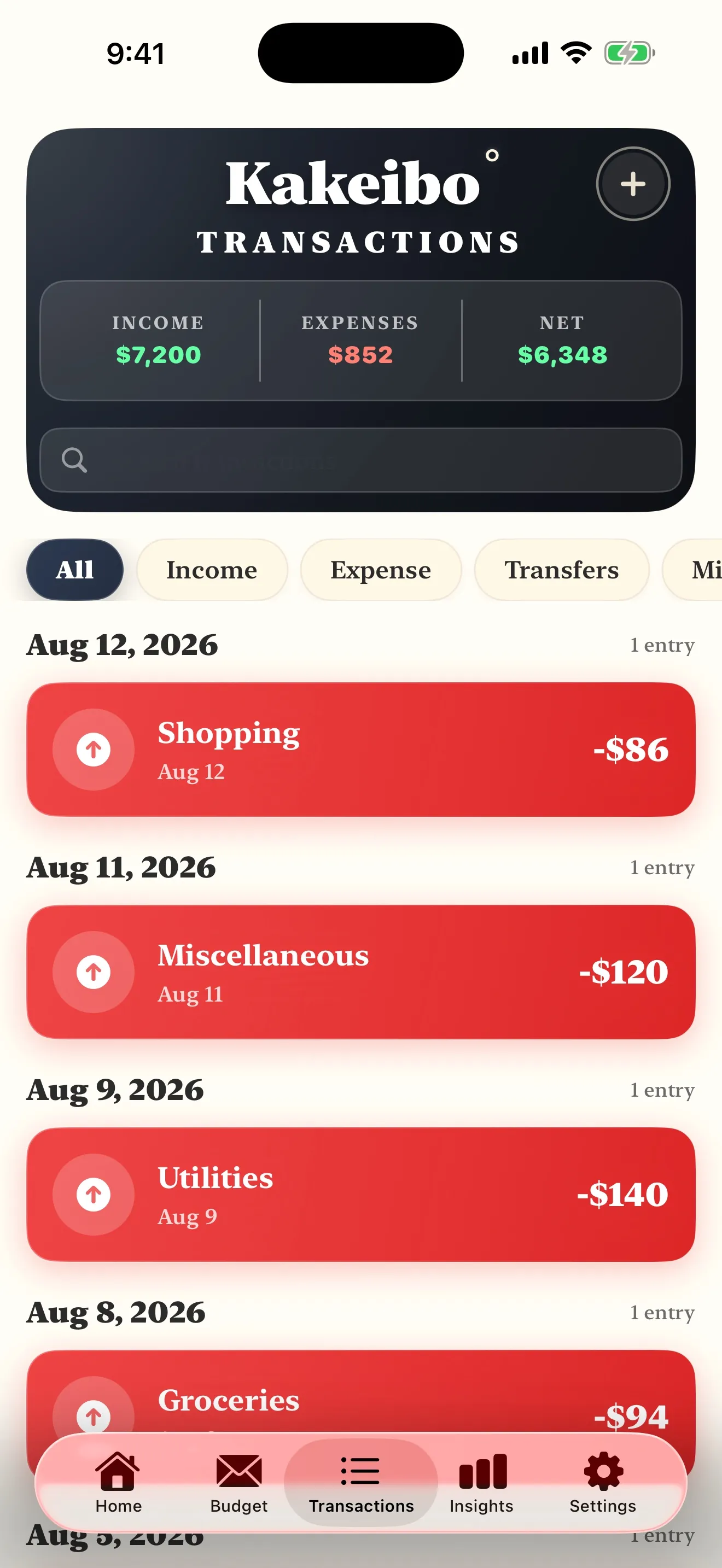
Get the Kakeibo app freeiPhone and iPad · Free tier, no account needed
The Kakeibo app transaction list showing a date header with one full entry logged beneath it