The hard cases
Needs versus wants in kakeibo
Four envelopes settle most of a month in about a second each. This guide is about the rest: the receipt that is two purchases, the object whose job changed, and the expense that is a necessity in your house and an indulgence in the one next door.
- Published
- 15 September 2026
- Written by
- The Kakeibo Method team
- Reading
- 9 minutes
- Filed under
- Starting a ledger
Kakeibo does not split spending into needs and wants. It splits it four ways, and the line most people mean runs between Survival and Optional: Survival is what the household stops functioning without, Optional is everything else you chose. Where a case is genuinely borderline, decide it by the job the money is doing rather than by the object, write the rule down, and then keep it.
This guide starts where a definition stops being enough. If you have not met the envelopes themselves, read the four categories explained first: it defines each one and sorts a long list of ordinary household expenses into them. What it cannot do, and what no published list can do, is tell you which envelope something belongs in when the answer depends on your household rather than on the thing you bought. That is this page.
Why a list of needs is always wrong for somebody
Because need is not a property of an object. It is a property of the job the object is doing, for a particular household, in a particular month. A car is a necessity if it is how you reach the work that pays for everything and a luxury if it sits outside for six days out of seven. Childcare is Survival for the household where it is what allows two incomes to exist and something quite different for the household where it buys an afternoon. Broadband was an indulgence within living memory and is now the thing your income arrives through.
Every published needs and wants list quietly assumes a household, and it is never yours. This is not a flaw in kakeibo. It is the reason the method asks you to decide rather than handing you an answer key, and the deciding is where most of the information is. The month you argue with yourself about whether the gym is Survival is the month you find out what the gym is actually for.
Four tests, in the order to apply them
Run them in order and stop at the first one that gives you a clean answer. Most receipts are settled by the first test in about a second.
- The stop test. If this stopped tomorrow, would the household stop working or would it be unpleasant. Rent stopping means you move. Coffee stopping means a worse Tuesday. The first is Survival, the second is not, and the distinction is functional rather than moral.
- The job test. Ask what this purchase is for, not what it is. A train fare to work and a train fare to a friend's birthday are the same object doing two different jobs, and they belong in two different envelopes.
- The substitute test. Would the cheapest version have done the job. If yes, the cheapest version is Survival and the difference is Optional. That splits the lunch you had to eat from the restaurant you chose to eat it in, without pretending you should not have eaten.
- The repeat test. Whichever way you decide, could you decide it the same way every time for a year without having to think about it again. If not, the rule is too clever and it will not survive a busy week.
The cases that actually cause the argument
- The grocery shop with wine on it. Two purchases on one receipt. Split them: food is Survival, the wine is Optional or Culture depending on whether it was a Tuesday or a dinner with friends. This split is worth doing because grocery spending is large and the mix inside it is exactly what a household wants to see.
- The car. Sort it by the job. Commuting to the job that pays for the household is Survival, including the insurance and the fuel that make it work. A second car kept for weekends is Optional. A car you love and drive for pleasure has a Culture argument in it and you are allowed to make it, once, in writing.
- The phone. The line is Survival, because it is how work, school and emergencies reach you. The upgrade you did not need is Extra, because it is a one off purchase rather than a running cost. Streaming bundled into the plan is Culture, and if it is impossible to separate, leave the whole thing where the line sits and stop apportioning.
- The gym. Survival if a doctor or a genuine health requirement put you there. Culture if it is how you spend your time and you would defend it. Optional if it is a direct debit you are embarrassed about. All three are honest answers and they tell you different things about the same charge.
- Takeaway after a very long shift. This is the case that exposes a moralised ledger. It is Optional by the stop test, and it may also be the single most reasonable thing you bought all week. Recording it as Optional is not a criticism, it is a description, and the month will make more sense if those two are kept apart.
- The haircut. Survival if the job requires it, Optional otherwise, and the same household can hold both answers for two different people in it. Pick once and keep it.
- A present for somebody else. Culture, in almost every case, because it is spending on a relationship rather than on yourself or on the running of the house. A large one off gift is Extra.
- The thing that broke. A replacement boiler, a new tyre, the laptop that died in the week you needed it. Extra: it is unplanned and irregular, and the whole reason Extra exists is that a household which has no envelope for the unexpected treats every unexpected month as a personal failure.
The two envelopes a needs and wants split has no room for
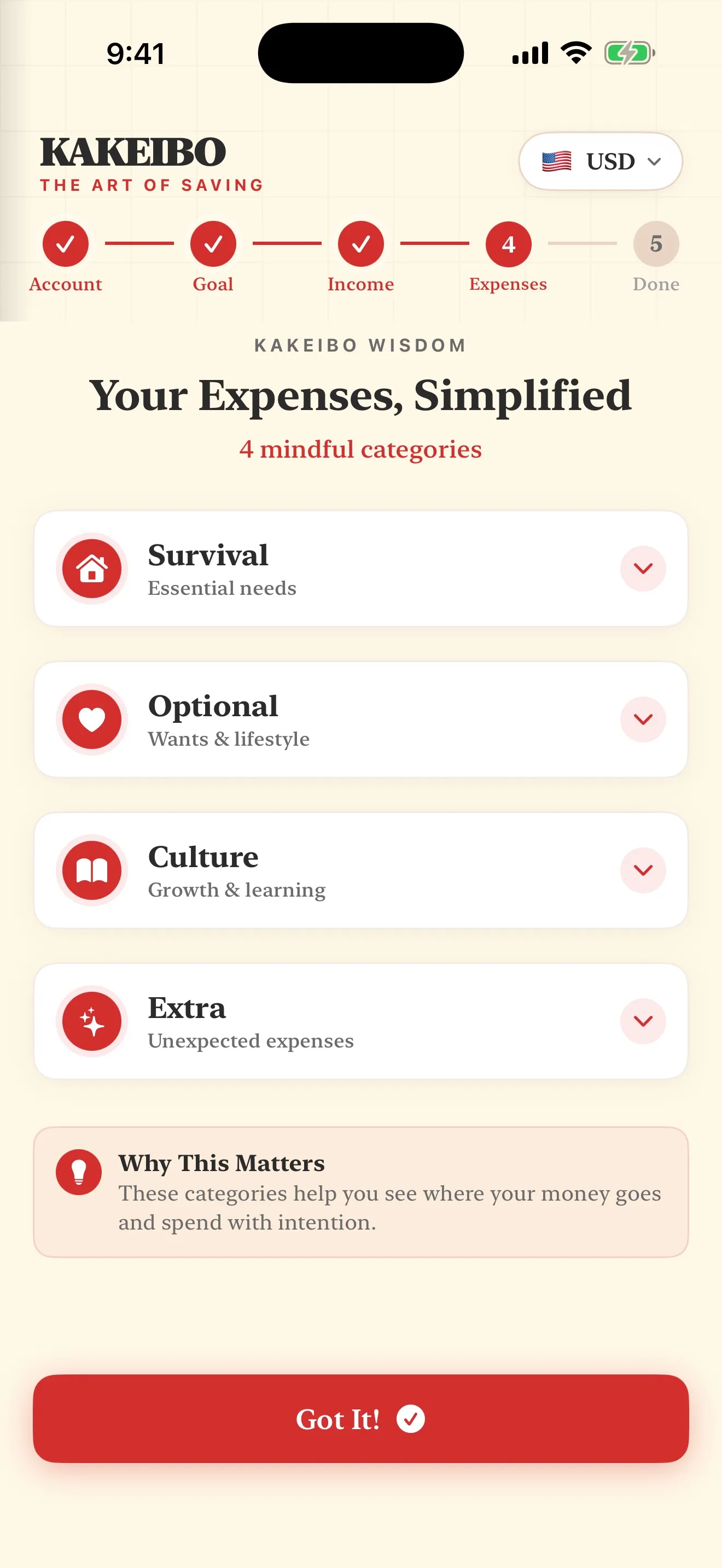
Culture and Extra are the reason kakeibo splits four ways rather than two, and they are both doing work that a binary cannot. Culture is spending on being a person: books, music, a cinema ticket, a class, a meal with people you like. It is not a need and calling it a want flattens it into the same bucket as a bad impulse purchase, which is both unfair and unhelpful. A household that finds out its Culture figure is near zero has learned something a needs column would never have shown it.
Extra is the unplanned and the irregular: the repair, the vet, the wedding you were invited to in March. It is not a want either. Its job is to stop one bad month reading as a moral collapse, and a household that funds it deliberately, even at a small figure, stops being ambushed by ordinary life. There is more on that in kakeibo on a low income, where a funded Extra matters most and is hardest.
Do not let the envelopes become a verdict
The fastest way to break a ledger is to make Optional the shameful column. The moment a category feels like a judgement, the household starts filing things where they look better rather than where they belong, and a ledger that has been gamed records nothing at all. The four envelopes describe what money was doing. They do not score it.
This matters more than it sounds, because the monthly reflection is supposed to be a reading rather than a trial. A large Optional figure that you chose deliberately, understood at the time and would choose again is a fine month. A small one you cannot account for is worse, and no needs and wants split would have told you which you had. The prompts for that reading are in the four questions guide.
Write the rule down the first time, then stop deciding
Every borderline case should be decided once and then recorded somewhere you will see it: the back page of the notebook, a note in the app, a tab in the sheet. Not because the rule is important in itself, but because a category that moves with your mood makes two months incomparable, and comparing months is most of what a ledger is for.
If a rule turns out to be genuinely wrong, change it at a month boundary and write down the date you changed it, so a jump in a category total has an explanation attached rather than looking like a change in behaviour. And keep the list short. A household that has written down more than a handful of special cases has usually built a taxonomy rather than a budget, and a taxonomy is the thing people abandon in week three. If the month has already gone badly wrong, that is a different problem with a different answer: what to do when you blow the budget.
Common questions
- Does kakeibo use needs and wants?
- Not in those words. Kakeibo splits spending four ways rather than two: Survival, Optional, Culture and Extra. The needs and wants line most people are thinking of runs between the first two, and the other two exist because a great deal of ordinary spending is neither a necessity nor an indulgence, which is exactly where a two way split fails.
- Is a car a need or a want?
- It depends entirely on what the car is doing. A car that gets you to the job that pays for everything is Survival, and so is the insurance and the fuel that makes it work. A second car kept for weekends is Optional. The same object can be both in the same household, which is why the test is about the job rather than the thing.
- What if something is half a need and half a want?
- Split it if the split is real and easy, and stop splitting it the moment it becomes an accounting exercise. A grocery shop with wine on it is genuinely two purchases and is worth separating. A phone plan slightly larger than you strictly need is one purchase, and the whole thing belongs wherever the phone belongs, because the minutes you would spend apportioning it are worth more than the accuracy you would gain.
- Are wants bad?
- No, and a household that treats Optional as the shameful envelope will stop recording honestly within a fortnight. The four categories are a description of what money is doing, not a scoring system. A month with a large Optional figure that you chose deliberately is a better month than one with a small figure and no idea how it got there.
- What if my answer changes from month to month?
- Write the rule down the first time you decide it and keep it for the year. A category that moves depending on your mood makes the totals incomparable, and comparability is most of what a ledger is for. If a rule turns out to be genuinely wrong, change it at a month boundary and note the date you changed it.
- Where do savings and debt payments go?
- The savings promise is not spending at all: it comes off the top before the four envelopes are filled. Minimum payments on a debt behave like a fixed bill and sit in Survival. Anything you pay above the minimum is a choice you are making with money you could have spent, and it belongs with the promise rather than in the spending plan.
Read nextThe whole library →
Where this one leads
You are holding a receipt that fits two envelopesThe four categoriesA working list of everyday expenses sorted into each envelope, with the awkward cases argued out rather than avoided.8 min readThe month is over and you have to write somethingThe four questionsThe four questions in the order the method asks them, a weekly check, and prompts you can answer in fifteen minutes.6 min readThe month is already over budgetWhen you blow the budgetRe-plan the rest of the month from what is genuinely left, rather than closing the book until the first.8 min read
Decide it once, keep it for the year
The borderline cases are where the information is, and they are also where ledgers go to die. Four tests, a rule written down, and a month that can be compared with the next one.
Get the Kakeibo app freeiPhone and iPad · Free tier, no account needed