294 worked targets
Pick the number you are actually saving for
Each page leads with the monthly, weekly and daily figure, then does the part the listicles skip: which of the four kakeibo envelopes gives the money up, and what the plan asks of your income.
A savings target is one division and a lot of avoidance. The division is here, for 14 common targets across 7 horizons in 3 currencies. The avoidance is what the kakeibo part is for: a target only becomes real when you can name the envelope it comes out of, and that is on every page below.
If your number is not on the grid, the save an amount by a date calculator takes any figure and any date. If you are new to the four envelopes, start with what is kakeibo.
Down for the target, across for the time
Each sheet is one currency. The rows are the amount you are saving for and the columns are how long you are giving yourself; the large figure in a cell is what that plan costs a month and the small one is what it costs a day. Every cell is a page, and every page works the same target out in full.
The shade is the DAILY figure, which is the number that decides what kind of decision you are making. The lightest plan on the grid is $500 over 36 months at $0.46 a day; the heaviest is $100,000 over 3 months at $1,095.14. Both are division. Only one of them is a budgeting question.
Above $50 a day the money stops coming out of Optional alone and starts coming out of rent, transport and insurance. That is where the two darkest shades begin, and 40 of the 98 plans on each sheet are in them. It is the honest line, and it is the one most budgeting pages leave out.
- Under $3a dayBarely registers against a day. The risk is forgetting it, not affording it.
- $3 to $8a dayOne recurring habit, found inside Optional without anything you would call a sacrifice.
- $8 to $20a dayTwo or three habits at once. The ledger is what tells you which ones.
- $20 to $50a dayA real reallocation. Something in the month gets smaller, and you choose what.
- $50 to $120a dayBeyond what habit changes deliver. A fixed cost has to move, or the date does.
- $120 and upa dayNot a budgeting problem. An income, housing or timeline decision.
Written for the United States. Every page on this sheet quotes a two week rate alongside the monthly figure, measures the income ladder against your paycheck, and reads Survival as rent or mortgage, groceries, utilities, gas, insurance.
Swipe the sheet for the longer horizons
On the longest horizon here, three years, a target of up to $54,787 stays under the $50 a day line. Past that the plan has to reach into fixed costs whatever the date says.
Written for the UK. Every page on this sheet quotes a fortnightly rate alongside the monthly figure, measures the income ladder against your salary, and reads Survival as rent or mortgage, the weekly shop, energy, council tax, travel.
Swipe the sheet for the longer horizons
On the longest horizon here, three years, a target of up to £54,787 stays under the £50 a day line. Past that the plan has to reach into fixed costs whatever the date says.
Written for Australia. Every page on this sheet quotes a fortnightly rate alongside the monthly figure, measures the income ladder against your pay, and reads Survival as rent or mortgage, groceries, power, rego and fuel, insurance.
Swipe the sheet for the longer horizons
On the longest horizon here, three years, a target of up to A$54,787 stays under the A$50 a day line. Past that the plan has to reach into fixed costs whatever the date says.
The amount is usually fixed. The date is the lever.
Moving down the sheet
Changing the amount changes what the money buys, so it is rarely free to move: a bond is a bond and a deposit is a deposit. When it can move, moving it is the fastest way to change the shade of the cell you are in, because the monthly figure is directly proportional to it.
Moving across the sheet
Changing the horizon costs you nothing but time, and it is the lever most people forget they are holding. $15,000 over three months is $5,000 a month; the same $15,000 over three years is $417. Same target, same method, a different life.
Reading the shade first
The useful habit is to pick the shade you can live in and then find the cells inside it, rather than picking a cell and hoping. A plan you can hold for the whole horizon beats a faster one you abandon in month three, and the ledger is what tells you which one you picked.
Common questions
- How do you work out how much to save each month?
- Divide the target by the number of months. Everything else on these pages, the weekly and daily figures, the income the plan implies and the envelope it comes out of, is built on that one division.
- Why is the daily figure worth knowing?
- Because it is the number you can act on. A monthly figure tells you whether the plan is possible; a daily figure tells you which habit has to change to make it happen.
- Do these pages account for interest?
- No. They are deliberately plain division, so the figure is the amount you have to move rather than a projection that depends on a rate. Anything a savings account pays you arrives early, which is the direction you want to be wrong in.
- Which currencies are covered?
- US dollars, pounds and Australian dollars, with the figures and the household examples written for each. That is 294 target pages in total across 14 amounts and 7 horizons.
The number is the easy half
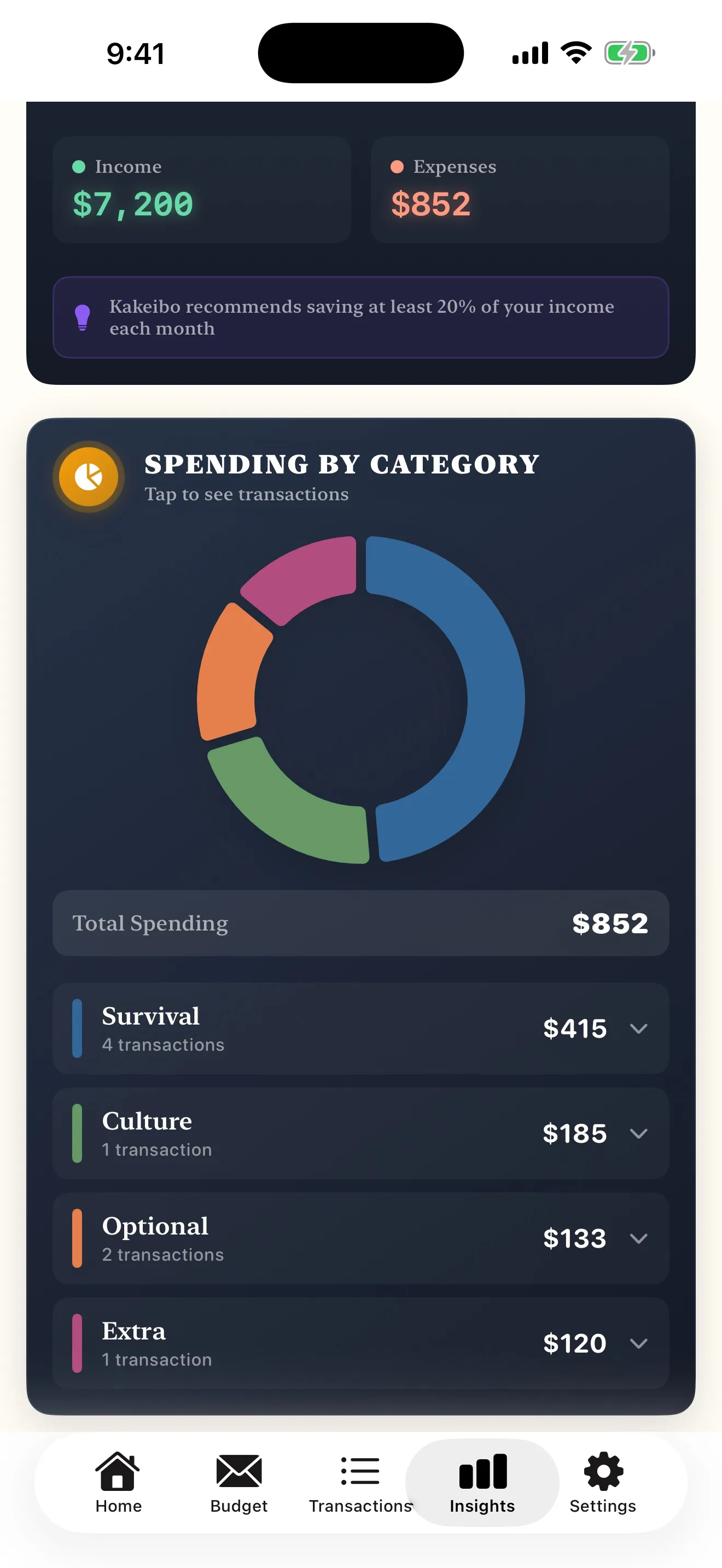
Every page here ends in the same place: the amount has to leave a real envelope every month. The app keeps that ledger, with the four categories and the monthly questions built in.