
Kakeibo MethodThe household ledger
Get the Kakeibo app free

The household ledger

Comparison

Kakeibo vs YNAB, envelopes and cash stuffing

Four methods that all divide money before it is spent, separated by about a century and a great deal of technology. They fail in different places, which is the only comparison worth making.

These four get lumped together because they share one insight: money divided in advance behaves differently from money sitting in a single account. Everything after that insight is different, including what each one asks of you and where each one falls over.

The short version

  • Kakeibo teaches you your own spending, by hand, and makes you write down what you will change.
  • YNAB plans your money forward and is excellent at irregular bills, for a subscription fee.
  • The envelope method enforces hard limits with physical cash.
  • Cash stuffing is the envelope method plus a camera, and the camera is doing more work than people admit.
KakeiboYNABEnvelopesCash stuffing
OriginHani Motoko, Japan, 1904Jesse Mecham, software, 2004American household practice, mid twentieth centurySocial media, revived from envelopes in the 2020s
Core ideaRecord, sort into four, reflect monthlyGive every unit of money a job before it is spentPhysical cash divided between labelled envelopesEnvelopes, filmed, with cash counted on camera
CategoriesFour, fixedAs many as you buildOne per envelope, usually six to twelveUsually many, and decorative
Money typeAnyAny, built around bank accountsCash onlyCash only
CostFree, a notebookA paid subscriptionFreeFree, plus the binder
Ongoing effortAn entry per purchase, fifteen minutes a monthRegular reconciliation, front loaded setupRefilling envelopes each paydayThe same, plus filming
Strongest atAwareness and the written monthly reviewForward planning and irregular billsHard spending limitsMotivation and habit formation
Weakest atForecasting future monthsCost, and the learning curveCards, online spending, safetyEverything the camera is not pointed at

Kakeibo, in one paragraph

Published by Hani Motoko in 1904 as a household ledger: four categories, savings decided before spending, entries written as they happen, and four questions answered at the end of each month. Its strength is diagnostic. A month of honest entries tells you things about your own behaviour that no automatic categorisation ever will, because the noticing happens at the moment of purchase rather than in a report. Its weakness is forecasting: it is a record of what you did, and it takes several months before it starts predicting what you will do. Full method in what is kakeibo.
YNAB

You Need A Budget started in 2004 and runs on a strict rule: every unit of money gets a job the moment it arrives. It is genuinely excellent at the thing paper is worst at, which is planning for costs that do not arrive monthly. Insurance, car registration and Christmas stop being ambushes because you have been setting aside a twelfth of each all year.

Two honest drawbacks. It costs a subscription, which is a real consideration for the household most in need of a budget, and it has a learning curve measured in weeks. It also automates the categorisation that kakeibo deliberately leaves to you, which makes it faster and less educational at the same time.

If your problem is irregular bills, YNAB is the better tool and we would rather say so than sell you a notebook.

The envelope method

An American household practice that predates all of the software: pay day arrives, cash is divided between labelled envelopes, and when an envelope is empty that category is finished for the month. Its strength is that the limit is physical, which no app can replicate, and it is the reason it still works for people who overspend on cards.

Its weaknesses are practical and worth naming: cash is unsafe to carry in quantity, most online spending cannot use it, and a growing share of everyday transactions are card only. Many households run a hybrid, with cash envelopes for groceries and eating out and cards for everything else.

Cash stuffing

The same envelopes, with the ritual filmed. It is easy to be sniffy about this and it would be wrong: the visible, tactile, repeated ceremony is doing real behavioural work, and it has brought a very large number of people to budgeting who would never have opened a spreadsheet.

The catch is what it optimises for. A method built around a satisfying payday ritual is strong at the moment of division and silent about the rest of the month, which is where the spending actually happens. Kakeibo is the inverse: the payday moment is a standing transfer that takes five seconds, and the practice lives in the hundred small entries afterwards. Anyone who arrived through cash stuffing and wants the analytical half will find the four envelopes familiar and the monthly reflection new.

What to pick

  • You do not know where your money goes: kakeibo, one month, no changes, just measurement.
  • Irregular bills keep ambushing you: YNAB, and it is worth the fee.
  • You overspend on a card and want a hard stop: cash envelopes for the categories that leak.
  • You need the habit to feel rewarding: cash stuffing to start, then a ledger once the novelty fades.
  • You want a target and no ritual at all: neither of these. Read kakeibo versus the 50/30/20 rule.

Combining them

These are not exclusive. A workable hybrid is a kakeibo ledger as the record, one or two cash envelopes for whichever categories genuinely leak, and a sinking fund for irregular bills in the spirit of YNAB. What does not work is running two full systems at once: the second one becomes admin and the admin is what gets abandoned in February.

If you are moving from cash stuffing to a ledger, the sorting question is the only new skill, and it is covered with a working list of examples. If you are moving from an app, the adjustment is logging at the counter rather than reconciling later, which is dealt with in kakeibo with a credit card.

Common questions

What is the difference between kakeibo and YNAB?
YNAB is forward looking software: you assign every unit of money a job before you spend it, across as many categories as you build, and it is very good at smoothing irregular bills. Kakeibo is backward looking and hand written: four categories, entries as they happen, and a monthly reflection. YNAB plans your money; kakeibo teaches you your spending.
Is cash stuffing the same as kakeibo?
No. Cash stuffing is the American envelope system with a camera on it: physical cash divided between labelled envelopes. Kakeibo is a written ledger with four categories and a monthly reflection, and it has never required cash. They are often confused because both use the word envelope, and both do work for the same reason, which is that dividing money in advance makes limits visible.
Can I do kakeibo without cash?
Yes, and most people should. What the method requires is that you record the spending yourself, close to the moment of the decision, and sort it into one of four categories. A card and a phone satisfy that as well as notes and a notebook do, provided you actually log at the counter.
Which method is best for someone in debt?
If the problem is irregular bills catching you out, YNAB earns its subscription. If the problem is that you do not know where the money went, kakeibo is cheaper and more diagnostic. In both cases minimum payments are a fixed cost and anything above the minimum belongs with the savings promise rather than with spending.
Which is best for a couple?
YNAB, if both of you will reconcile it, because it was built for shared accounts. Kakeibo works jointly only when both people write their own entries into one ledger, since the recording is the intervention rather than the record keeping.

Different methods, same underlying trick

Divide the money before you spend it, and look at what happened afterwards. Kakeibo is the version that makes you write the second half down.

Get the Kakeibo app freeiPhone and iPad · Free tier, no account needed
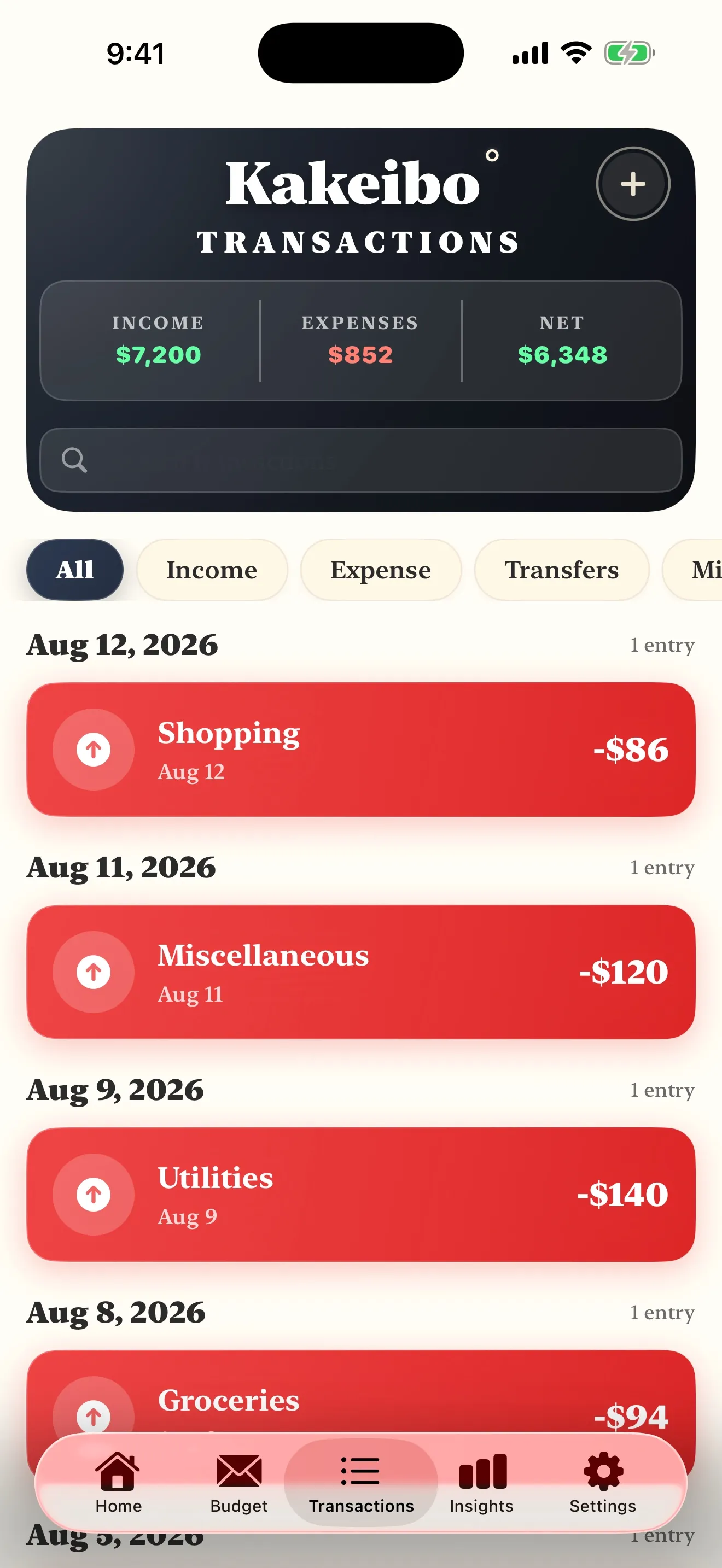
The Kakeibo app transaction list showing income and expenses grouped by date