
Kakeibo MethodThe household ledger
Get the Kakeibo app free

The household ledger

Free calculator

Kakeibo against 50/30/20

One income, two allocations, drawn side by side. The interesting part is not the amounts, it is what each method does when the amounts turn out to be wrong.

Side by side allocator

They are not the same kind of thing

50/30/20 is an allocation rule. It was popularised by Elizabeth Warren and Amelia Warren Tyagi in All Your Worth (2005), and it answers one question: what proportion of take home pay should go where. Half to needs, thirty percent to wants, twenty percent to savings and debt repayment above the minimum.

Kakeibo is a practice. Hani Motoko published it in 1904 as a household ledger with four questions attached, and it answers a different question: what actually happened, and what will you do about it. It has no percentages, and any version you find quoting official kakeibo ratios has added them.
The structural difference

The rule fails loudly and silently at once. When Survival costs exceed half your income, which is common, 50/30/20 tells you that you are wrong and offers no next step. Kakeibo has nothing to fail: the promise is whatever you decided it was, the envelopes are whatever is left, and the monthly reflection is where you decide what to change. That makes it slower to set up and considerably harder to abandon.

The reverse is also true and worth saying. If you want a target without a ritual, the rule is better. It takes thirty seconds and it does not ask you to write anything down for a month before it tells you anything.

The full comparison, including where each one breaks, is in kakeibo versus the 50/30/20 rule. If you want the four envelopes on their own, use the kakeibo calculator.

Common questions

What is the difference between kakeibo and the 50/30/20 rule?
The rule allocates: half of take home pay to needs, a third to wants, a fifth to savings. Kakeibo sequences: decide the savings first, take it out, then divide what is left across four envelopes and write down what actually happens. One is a target ratio, the other is a habit with a monthly review attached.
Which one saves more?
Neither, on paper. A ratio saves nothing until the money moves, and a ledger saves nothing until the entries are honest. The practical difference is that 50/30/20 is easier to start and kakeibo is harder to fool, because it asks you to write the spending down while it happens.
Can I use both?
Yes, and it is a sensible combination. Use 50/30/20 to set the savings promise, then run kakeibo underneath it to decide where the remainder goes and to check monthly whether the promise survived contact with real life.
Does 50/30/20 work on a low income?
Often not, and that is the honest criticism of it. When Survival costs are well above half of take home pay, a fixed ratio just tells you that you are failing at arithmetic you did not set. Kakeibo has no such rule to fail, which is one reason it travels better across incomes.

Pick the ratio you like. Keep the ledger either way.

The allocation is a starting position; the entries are what turn it into something you can improve. That is the part kakeibo has always been about.

Get the Kakeibo app freeiPhone and iPad · Free tier, no account needed
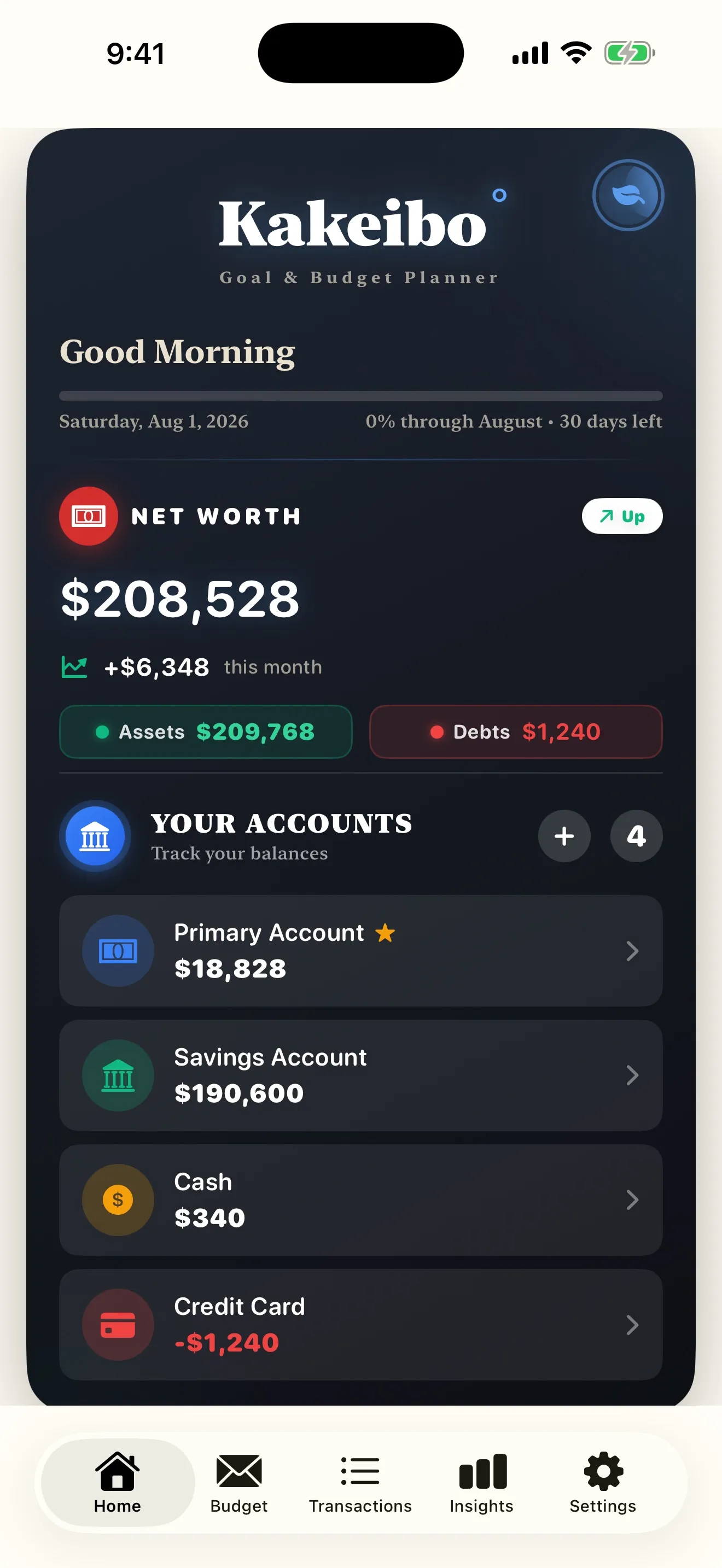
The Kakeibo app home screen showing net worth, accounts and the month's progress