
Kakeibo MethodThe household ledger
Get the Kakeibo app free

The household ledger

Free calculator

The four category split

Plans are easy to write. This reads the other direction: put a real month in and see the shape it actually had, envelope by envelope.

Month reader

Four envelopes, not twenty categories

Banking apps sort spending into dozens of categories automatically, and the result is a pie chart nobody acts on. Kakeibo goes the other way. Four envelopes is few enough to hold in your head at the counter, which is the moment the decision is actually made, and the sorting is done by you rather than by a merchant code that thinks your supermarket lunch was groceries.

The categories are also chosen to make one specific tradeoff visible. Culture sits apart from Optional so that books, courses and exhibitions are not quietly cut alongside impulse shopping. That separation is the method taking a position: the first thing to go should not be the thing that improves you.
Reading the result honestly

A high Survival share is not a discipline problem. It is a housing, transport or income fact, and category willpower will not move it. A high Optional share is the opposite: it is the most changeable number on the page, and usually the one people most underestimate before they start writing entries down.

An empty Extra envelope is the most common finding of all, and the most expensive. Extra is what absorbs the repair, the gift and the vet, and a month that does not fund it borrows from the savings goal instead.

The full list of what belongs where, with everyday examples sorted into each envelope, is in the four categories guide. If you pay for most things by card, the sorting question changes shape, and kakeibo with a credit card deals with that properly.

Common questions

What are the four kakeibo categories?
Survival, Optional, Culture and Extra. Survival is what keeps the household running, Optional is what you enjoy and could stop, Culture is what improves you, and Extra is the irregular hit like a repair or a gift. Four is the point: a category list long enough to be accurate is too long to be used.
Which category does a takeaway coffee belong to?
Optional, in almost every case. The test is not whether you value it but whether stopping it would damage anything: rent would, a flat white would not. A coffee bought as the price of a two hour work session in a cafe is a judgement call, and kakeibo expects you to make it and then be consistent.
Where do debt repayments go?
The minimum payment is Survival, because missing it has consequences. Anything you pay above the minimum is a savings decision rather than a spending one, so treat it the way you would treat a transfer into a goal.
Is there a right percentage for each category?
No, and be suspicious of any site that publishes one as kakeibo doctrine. What the method gives you is the comparison: what you planned against what happened, read once a month, in writing. The ratio that matters is your own, measured over a few months.

The shape of your month, in four figures

Once you have seen it twice, the third month starts predicting itself. That is the point at which the method stops being admin and starts being useful.

Get the Kakeibo app freeiPhone and iPad · Free tier, no account needed
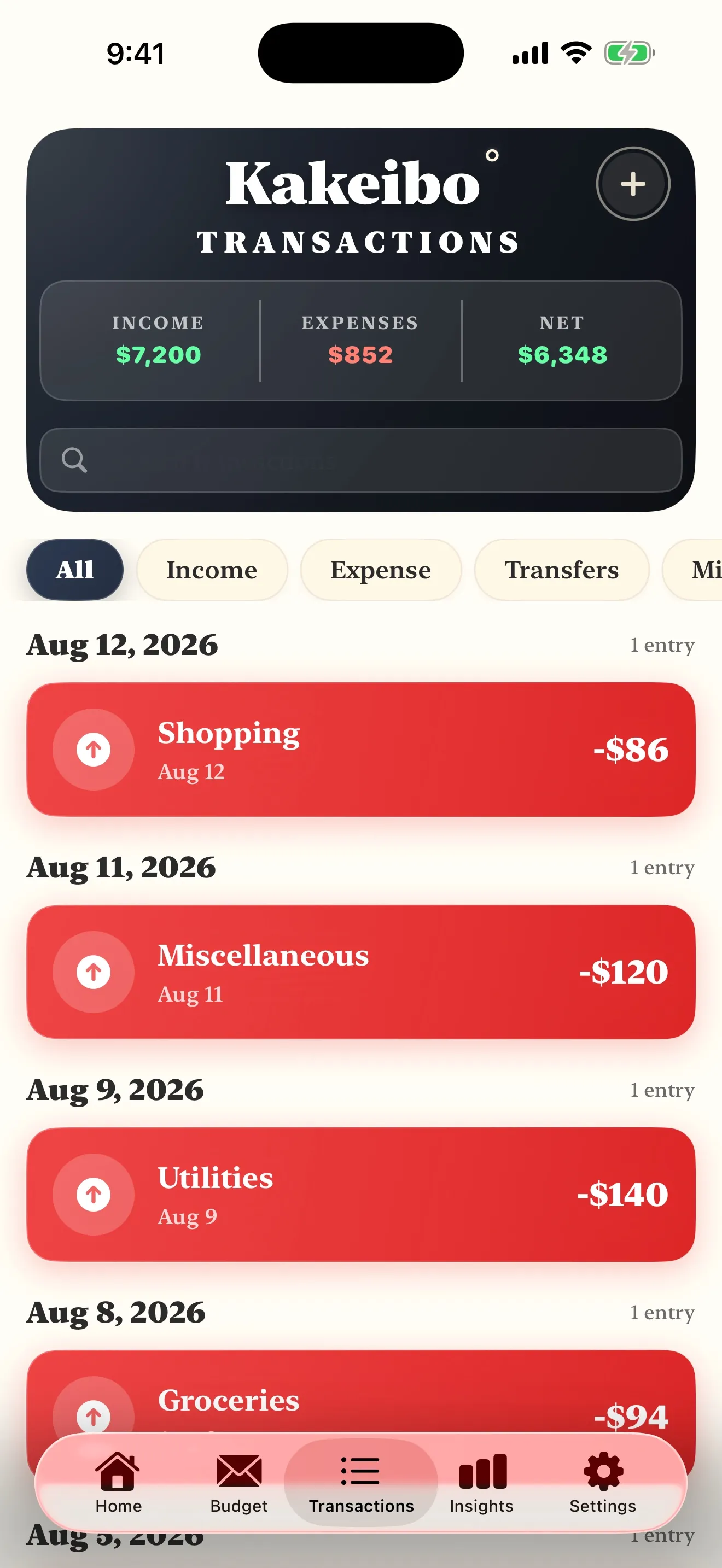
The Kakeibo app transaction list showing income and expenses grouped by date