Comparing methods
Kakeibo vs zero based budgeting
Both promise that no dollar goes unassigned. One decides the assignment in advance and calls it a line item. The other decides it afterward and calls it a question, and that turns out to matter more than it sounds.
- Published
- 10 September 2026
- Written by
- The Kakeibo Method team
- Reading
- 8 minutes
- Filed under
- The argument, and the record
Zero based budgeting and kakeibo are rarely put next to each other, which is odd, because they are the two systems in this niche built on the same instruction: nothing spends without being assigned somewhere first. Zero based budgeting assigns in advance, one line item at a time, until income minus every assignment equals zero. Kakeibo assigns the savings promise in advance the same way, then assigns everything else after the fact, once the spending has actually happened and can be sorted honestly instead of guessed at. The full mechanics of that second system, the four categories kakeibo sorts into, are in the kakeibo pillar; here they matter mainly as the place a zero based line item would otherwise have gone.
What each one actually asks you to do
Zero based budgeting starts from a blank page every month. List the income, then list every expense as its own named line, rent, groceries, the electricity bill, a clothing allowance, a dining out allowance, until the total of every line equals the income to the cent. Zero is the target, not a warning: it means every dollar has a job, including the dollars going to savings, which count as a line item exactly like the rent does.
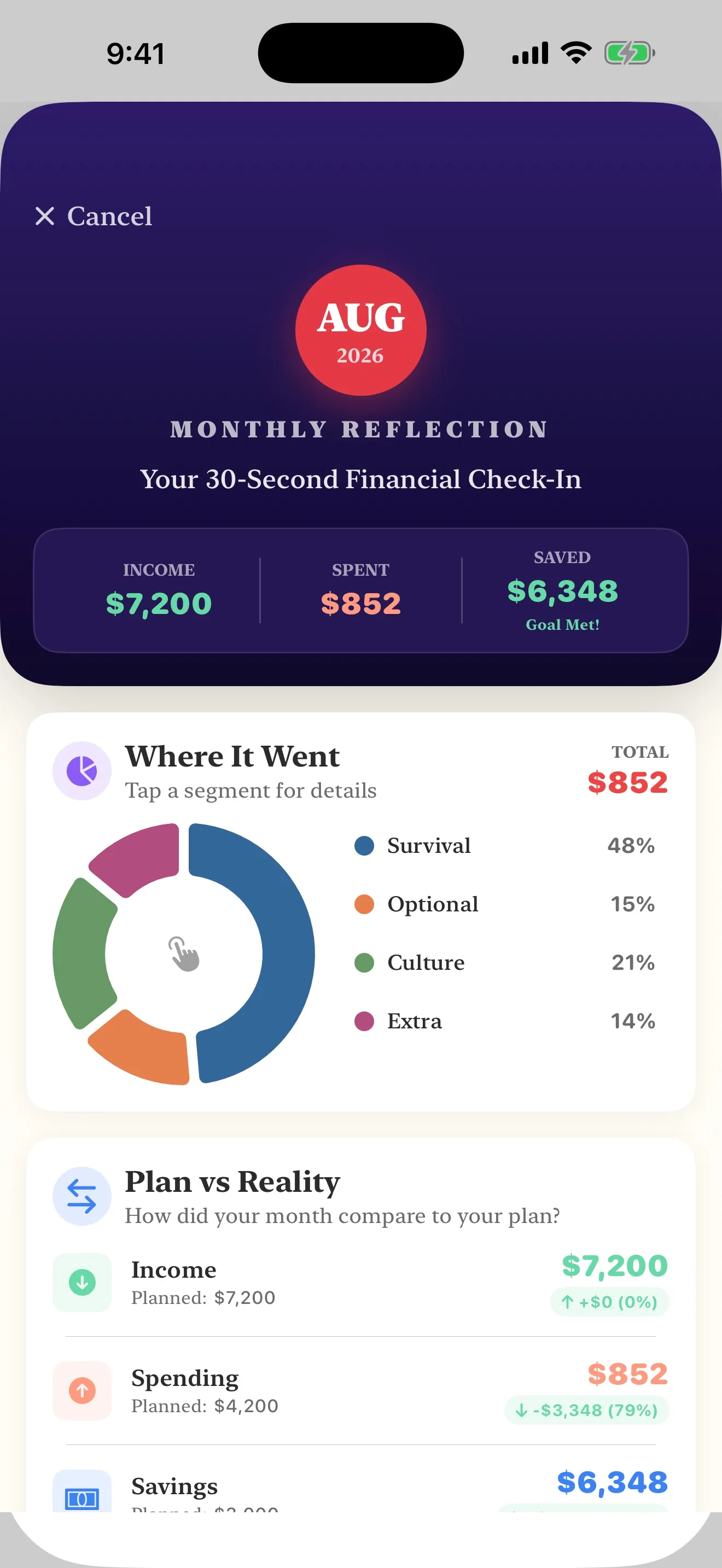
Kakeibo starts from what already happened. The savings promise is decided and moved out first, which is the same instruction zero based budgeting gives its own savings line. Everything else is recorded as it is spent, sorted into one of four categories, Survival, Optional, Culture and Extra, and only totalled at the end of the month, when the four questions ask how much came in, how much went out, whether the two matched the plan, and what changes next month.
The job in zero based budgeting is a line item, decided before the money moves. The job in kakeibo is a question, asked after it already has. Almost everything below follows from that one difference.
Where zero based budgeting genuinely wins
Zero based budgeting earns its keep wherever the line items themselves are the thing that changes, not the behaviour behind them. A freelance business with contractor invoices, advertising spend and materials costs that move independently of each other needs each of those named before the month starts, because no single category is patient enough to hold costs that different without hiding what each one actually did. Kakeibo's own answer to a variable income, planning from the lowest realistic month rather than the average one, still applies underneath either system, but it does not replace naming each business line separately once the number itself is the variable.
A month with a genuine fixed ceiling works the same way. A wedding month, the final stretch before a house deposit is due, a quarter where a business has one confirmed number to spend and no more, benefits from a plan that states the cap in advance, because there is no later month to look back on and adjust. The plan has to be right before the first receipt, not after it. A zero based pass for that one month might read: venue deposit already paid, catering four thousand, flowers and photography two thousand two hundred, everything else six hundred, total unchanged from the number agreed before anyone booked anything. There is no category in that list built to be reflected on afterward, because there is no repeat month coming to learn from.
Where kakeibo genuinely wins
A line item is the wrong tool for a spending habit you actually want to change, because a forecast only records the number you expected, and a category that is quietly growing looks identical to one that has plateaued until somebody asks why. Zero based budgeting has no mechanism built to ask that question: the dining out line either matched the plan or it did not, and a match tells you nothing about whether the plan itself was already too generous.
The kakeibo reflection asks it anyway, every month, on the same four categories, which is why the method works better on a habit than on a forecast. A household whose Optional spending was budgeted at four hundred dollars a month and has cleared exactly four hundred for six months straight looks, on a zero based sheet, like a plan that is working. The reflection asks the harder question a matched line item never has to: whether four hundred was ever the right number, or whether it was simply the number chosen the first month and repeated out of habit ever since. That is also why kakeibo has nothing useful to say about a cost that has never happened before, a wedding, a move, a new baby: there is no history to reflect on yet, and that is exactly the kind of month zero based budgeting is built for.
One household, both methods, on the same target
Take a household deciding to hold five thousand dollars in reserve inside twelve months, worked out in full on the five thousand dollar savings target page, which puts the monthly figure at a little over four hundred dollars. Run it as zero based budgeting first: the four hundred and seventeen dollars becomes a line item, assigned in advance alongside rent and groceries, and once it clears the account each month the plan is satisfied. The line item does not say where the money came from, only that it left, and for a target with a fixed date that is often enough.
Run the same target through kakeibo and the source becomes visible. The four category split calculator shows the same household's actual month sorted into Survival, Optional, Culture and Extra, and the reflection can say whether the reserve was funded by trimming Optional, which is a choice made on purpose, or by Survival quietly running short one month in three, which is a warning a zero based line item would not raise until a later month's plan failed to balance on its own. Both households hit the same five thousand dollars on the same date. Only one of them knows, twelve months in, whether it could do it again without a repeat of the month Survival came up short.
A migration path in both directions
Moving from zero based budgeting to kakeibo, the part worth keeping is the instinct, not the paperwork: keep insisting that nothing spends without a job, but stop redrafting a full line item list every month. Group the lines into the four categories instead, and let the monthly questions replace next month's forecast, since the forecast was only ever a guess at what the reflection can now report as fact.
Moving from kakeibo to zero based budgeting works best as a single bounded exercise rather than a permanent switch. Run one full zero based line item pass at the start of the one month that has a genuine hard cap, treat the categories as the headings the lines fall under rather than abandoning them, and return to the ordinary monthly reflection once that month is over.
Run zero based on Survival, kakeibo on everything above it
None of this requires choosing a single winner for every category at once. Survival, the costs that have to clear regardless, rent, the loan repayment, insurance, is naturally suited to a zero based line item, because the number rarely moves and there is little to reflect on once it has cleared. The categories above it, Optional, Culture and Extra, are naturally suited to the kakeibo question, because that is where a decision happens every week and where a habit actually drifts.
In practice that looks like one page rather than two systems: the top of the ledger lists Survival as a short set of fixed lines, named and totalled the way a zero based sheet would name them, and the rest of the page is the ordinary four category record, filled in as the month happens rather than guessed at before it starts. Nothing about combining them this way requires new software or a second notebook. It only requires deciding, once, which categories in a given household actually behave like a forecast and which ones behave like a habit, and then treating each the way it actually behaves.
This is not the only comparison worth reading before settling on a system. The kakeibo vs 50/30/20 calculator runs both plans against the same income, and the full set of comparisons, including that one, is at the comparisons hub. Whichever pairing a reader ends up choosing, the instruction underneath all of them is the same one this page opened with: nothing spends without a job.
Common questions
- Is kakeibo a form of zero based budgeting?
- No. They share one instruction, that every dollar gets a job, but they assign it differently. Zero based budgeting assigns in advance, one line item at a time, until income minus every line equals zero. Kakeibo assigns the savings promise in advance and then records everything else as it actually happens, sorting it afterward into four categories and asking what the month did.
- Where does zero based budgeting genuinely work better than kakeibo?
- Anywhere the line items themselves are the variable, not the behaviour behind them. A freelance income with contractor invoices, ad spend and materials costs that move independently needs each one named in advance, and a month with a real fixed ceiling, a wedding month or the last stretch before a deposit is due, benefits from a plan that states the cap before a single receipt tests it.
- Where does kakeibo work better than zero based budgeting?
- Anywhere the problem is a habit rather than a number. A line item only records what you expected to spend, so a category that quietly grows month over month looks identical to one that has plateaued until somebody asks why. The kakeibo reflection asks why, every month, which a forecast line item is not built to do.
- Can I run zero based budgeting and kakeibo at the same time?
- Yes, and splitting them by category is more useful than picking one. Fixed costs that rarely move, rent, a loan repayment, insurance, suit a zero based line item because there is nothing to reflect on. The categories above that, the ones where a decision happens every week, suit the kakeibo question because that is where spending actually drifts.
- Does zero based budgeting mean spending your entire income?
- No, and this is the most common misreading of the name. Zero refers to the balance after every dollar has a job, including the dollars assigned to savings. A household that saves twenty percent and spends the rest is still at zero once the savings line is counted as a line item like any other.
Read nextThe whole library →
Where this one leads
You are holding a receipt that fits two envelopesThe four categoriesA working list of everyday expenses sorted into each envelope, with the awkward cases argued out rather than avoided.8 min readNo two paydays are alikeKakeibo with irregular incomePlan Survival from your lowest realistic month, then give a good month a job.8 min readYou have read the savings claim and doubted itDoes kakeibo actually workThe figure everybody repeats, traced to nothing, then the three mechanisms that are genuinely defensible.9 min read
Two ways to give a dollar a job
One decides in advance and calls it a line item. The other decides afterward and calls it a question. Most households need both, just not on the same category.
Get the Kakeibo app freeiPhone and iPad · Free tier, no account needed