Family money
Kakeibo for families with children
A child does not object to a monthly ledger so much as ignore it. School costs land by term, sport lands by season, and a birthday season costs more than a birthday-free one for reasons that have nothing to do with how carefully the household is run. Here is which envelope those costs actually belong in, and what changes in the monthly reflection once someone smaller is in the house.
Kakeibo assumes a household whose costs repeat on a schedule: rent on the first, groceries every week, a bill that arrives the same week every month. A child does not break that assumption so much as ignore it. School fees and book lists land by term, a sports season needs a kit before its first week and nothing after, and a class excursion turns up on a note home with two weeks' notice and an exact price printed on it. None of that fits neatly into a ledger built around Survival's steady bills, which is why the honest version of kakeibo for a family with children has to say plainly where these costs go, who is allowed to see the numbers, and what changes in the monthly reflection once somebody smaller is in the room.
The costs that arrive with no notice
Three kinds of children's cost break the monthly rhythm the four envelopes assume. School costs arrive by term rather than by month: uniforms at the start of the year, a book list in the first week, an excursion with two weeks' notice and a fixed price on the note. Sport arrives by season: registration, a kit, sometimes a tour, then nothing until the next season starts. Birthdays and parties arrive on other people's calendars, not yours, and a term with three of them in it costs more than a term with none, for reasons that have nothing to do with how carefully your own household is run.
The instinct is to squeeze all three into Survival, because they feel necessary rather than optional, and necessary is the word most people use to decide what belongs in Survival. But Survival is for costs that repeat at roughly the same size every month: rent, the electricity bill, the weekly shop. A cost that is 220 dollars in February and nothing for the rest of the year is not that kind of cost, however unavoidable it is, and treating it as Survival means resetting your idea of what the household needs every time a note comes home.
Why Extra is the right envelope, worked through
Extra already exists for exactly this shape of spending, the large and the irregular, and children's costs are the clearest case for it a household will ever meet. List the known ones for a year: a school excursion at 250 dollars, a book list at 180, a sports season at 420 including the kit, a couple of birthday party contributions at 60 each. For two children that comes to something like 1,780 dollars across a year, and dividing it by twelve gives roughly 148 dollars a month that Extra needs to be carrying quietly, whether or not anything is actually due that month.
That monthly figure matters more than any of the individual costs do. A household that funds Extra at 148 dollars a month has the excursion fee and the sports kit covered the day the note comes home, because the money was already there rather than needing to be found. A household that waits for each bill and pays it out of whatever is left in Survival is not saving anything by skipping the monthly set-aside. It is only moving the same total spending into the month it happens to land in, and making that month feel tight for reasons nobody planned for.
A children's line the family can actually see
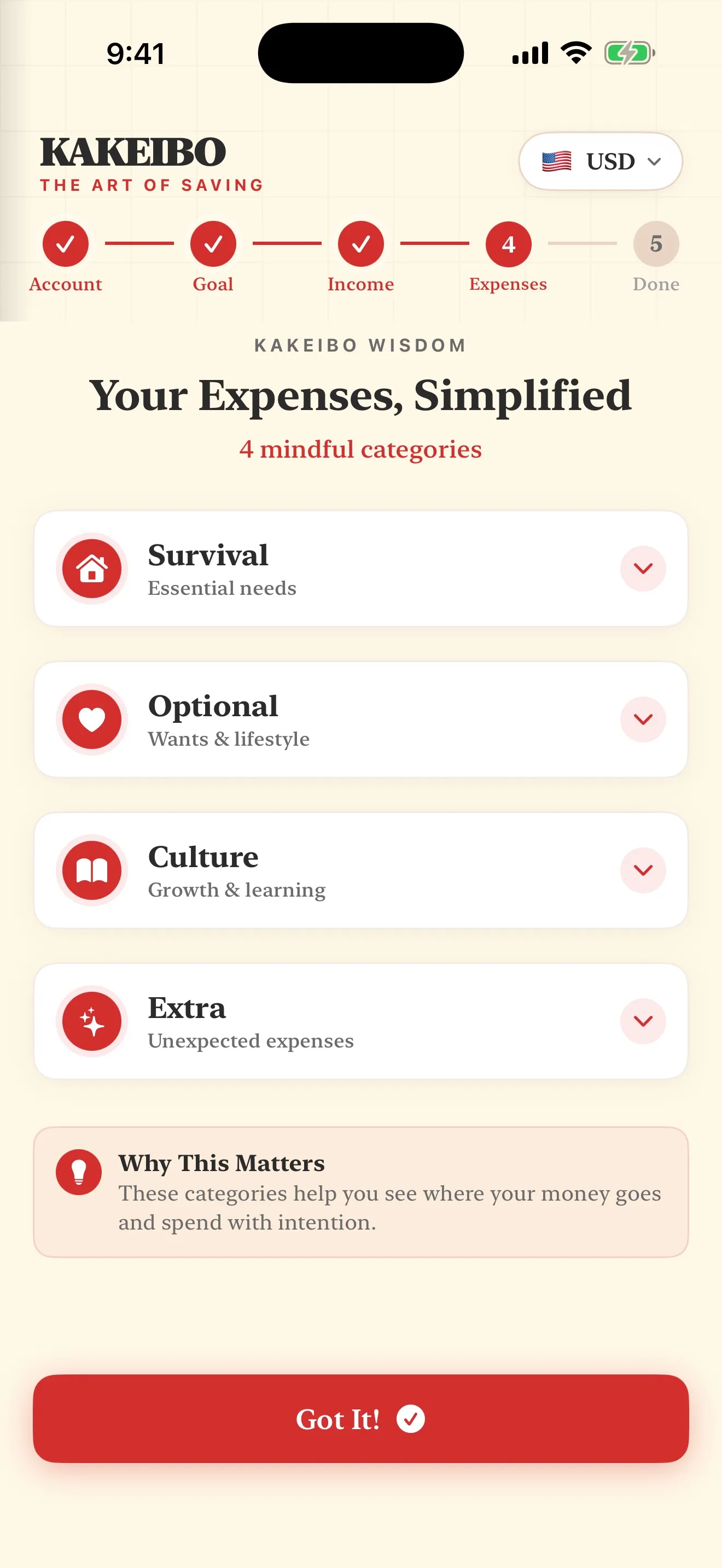
Rather than letting these costs blend into Extra's general total, give them their own line inside it: one number, checked at the same time as the rest of the reflection, that says what the household has set aside for children's costs and what has actually come out of it this month. This is not a fifth envelope. The four categories still hold, the way the four categories guide sets them out, and a children's line inside Extra is a way of reading that envelope rather than a new one sitting beside it.
The reason to make it visible rather than folding it quietly into Extra's total is the same reason kakeibo asks for any of its categories: a number you can see is a number you can decide about. A children's line that only ever grows is worth noticing before the next sports season arrives, not after it has already landed.
Getting the total funded before it is needed
Work the annual total out once rather than guessing at it every term. If a round number is easier to plan against than the exact 1,780 dollars above, the 3,000 dollars in 12 months page already carries a comfortable version of that figure through to a monthly, weekly and daily amount, and adjusting it against your own list of known costs takes less time than reworking the division by hand. Whatever the number comes to, it belongs in Extra, funded monthly, and worth checking against the four category split calculator at the end of a term to see whether children's costs are actually landing where you planned or quietly leaking into Survival.
At what age a child starts recording their own
There is no fixed age the method hands you, but the useful marker is not a birthday, it is the first time a child has money that is genuinely theirs to decide about: pocket money, a small allowance, cash from a relative. That is the moment a simple version of the ledger becomes worth handing over, one envelope rather than four, amount in, what it was for, nothing more. A child does not need Survival, Optional, Culture and Extra to get the benefit of the method. They need the habit of writing an amount down at the moment they decide to spend it, which is the whole mechanism kakeibo runs on for an adult as well.
Keep their record separate from the household's. The point is not to fold a child's five dollars into the family total, it is to let them practise the one habit that makes the method work, on money small enough that a mistake costs nothing to learn from.
The reflection, with someone smaller in the house
The monthly reflection still runs on the same four questions the couples guide sets out for two adults, and having children in the house does not change the questions, it changes who is in the room when you ask them. Run the reflection itself, the honest one, after the children are in bed or otherwise occupied. It is where a shortfall gets named plainly and where two adults might disagree about a category, and none of that needs an audience who is not old enough to be part of the decision.
What can happen in front of them, and is worth doing on purpose, is the small visible habit: writing an entry down at the table after a purchase, saying the amount out loud, treating the ledger as an ordinary object rather than a subject that goes quiet when a child walks in. Children learn the shape of a habit from watching it far more than from being told about it, and a household that only ever talks about money in hushed tones after bedtime is teaching a lesson too, just not the one it means to.
What should not happen in front of the children
Three things are worth naming plainly rather than leaving to instinct in the moment. Do not turn a shortfall into blame directed at either parent while a child can hear it: the four questions ask what happened and what changes, not whose fault it was, and a child who hears money turned into an argument learns to be afraid of the subject rather than competent at it. Do not discuss debt totals or income specifics where a child can repeat them, not because the numbers are shameful but because a child has no way to hold that information usefully and every way to worry about it. And do not make a child's own small spending the subject of the adult reflection. Their five dollars is theirs to account for in their own small ledger, not a line item in the household's.
A workable setup for a family with children
- List the known annual costs, school, sport, birthdays, and total them.
- Divide by twelve and fund that figure into Extra every month, before any of the individual bills land.
- Keep a children's line inside Extra so the number stays visible rather than blended in.
- Once a child has money of their own, hand them a one envelope version of the ledger, kept separate from the household's.
- Run the honest monthly reflection without the children present; model the small habit of logging an entry in front of them instead.
- Check the shape of the month against the four category split calculator each term, to see whether children's costs are landing in Extra or leaking into Survival.
None of this changes what the kakeibo method already asks for: a savings promise first, four envelopes for what is left, and a monthly reckoning that says plainly what happened. A household with children just has one more kind of cost to place honestly, and one more person, eventually, learning to place it themselves.
Common questions
- Where do children's costs like school and sport fit in kakeibo?
- In Extra, not Survival. Survival holds costs that repeat at roughly the same size every month, and a school excursion or a season’s sports kit does not repeat that way even though it is unavoidable. Extra is the envelope built for the large and the irregular, and children’s costs are the clearest example of it most households will ever have.
- Should a family budget children's costs monthly or pay for them as they arrive?
- Fund them monthly and let the bills arrive whenever they arrive. List the known costs for a year, divide by twelve, and set that figure aside in Extra every month regardless of whether anything is actually due. Paying each bill out of whatever is left in Survival when it lands does not save any money, it just turns a predictable term into a month that feels like a crisis.
- At what age should a child start keeping their own kakeibo entries?
- Whenever they first have money that is genuinely theirs to decide about, such as pocket money or a small allowance, rather than at a fixed birthday. A single envelope version, the amount and what it was for, teaches the habit that matters without needing the household’s full four categories.
- Should children be in the room for the monthly reflection?
- Not for the honest version of it. Run the four questions with just the adults present, since a shortfall or a disagreement about a category does not need an audience too young to be part of the decision. What is worth doing in front of children is the smaller habit, writing an entry down after a purchase and saying the amount out loud, so the ledger reads as an ordinary object rather than a subject that goes quiet when they walk in.
- How is this different from kakeibo for couples?
- It sits on top of it rather than replacing it. Two adults still need one shared ledger and a joint reflection, exactly as the couples guide sets out. A family with children adds a visible line for costs that arrive by term or season rather than by month, and a decision about when a child gets a small ledger of their own.
Fund Extra once. The school notice stops being an emergency.
List the known costs for a year, divide by twelve, and let Extra carry them quietly until the note comes home. That is the whole adaptation this method needs for a family.