Cash and the ledger
Cash envelopes alongside kakeibo
Two systems that look like rivals from a distance and turn out to answer different questions up close: one stops a purchase before it happens, the other records it afterward and asks why. Here is where the boundary between them actually sits.
- Published
- 22 September 2026
- Written by
- The Kakeibo Method team
- Reading
- 9 minutes
- Filed under
- What you keep it in
The comparison page on this site puts cash envelopes, cash stuffing, YNAB and kakeibo next to each other and argues each one's case. What it does not do, because it is answering a different question, is tell you how to run a cash envelope and a kakeibo ledger at the same time. This guide is that page. It assumes you already know what kakeibo is and have decided you want both, and just need to know which category the cash actually belongs in.
The short version: cash constrains before you spend, because an empty envelope is empty. The ledger reviews after you spend, because a recorded entry can be read back and questioned. Those are not two ways of doing the same thing. They are two different moments in the same purchase, and a household can use both without either one being redundant.
Which categories can actually hold cash
Not all four. The test is simple: does the money leave your hand, or does it leave your account without you being anywhere near it.
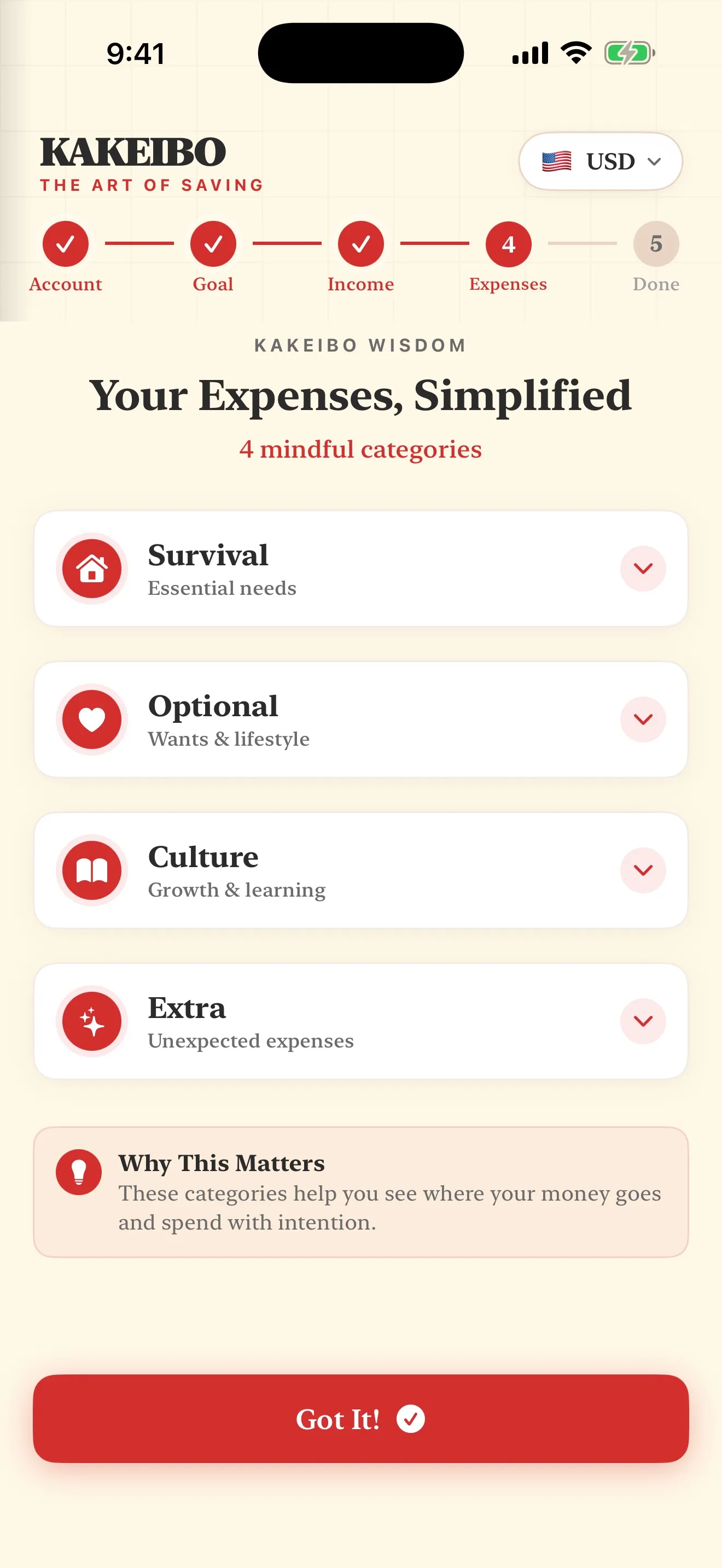
- Survival, almost never. Rent or a mortgage payment, a loan repayment, insurance and most utilities go out by direct debit on a fixed date, and no amount of cash in an envelope changes that. Putting Survival in cash means withdrawing the rent in banknotes and walking it to a landlord, which is not how anyone actually pays rent in 2026. Leave Survival exactly where it already is.
- Optional, cleanly. Coffee, takeaway, a round of drinks, an impulse purchase at the shops: this is spending that happens in person, in the moment, which is precisely what a physical limit is good at interrupting. This is the envelope worth building the whole system around.
- Culture, sometimes. A secondhand book or a ticket bought at the door works fine in cash. A course subscription or an app does not, because there is no counter to hand cash across. Culture splits roughly in half between the two, so it is not worth forcing into either system on principle.
- Extra, practically never. A car repair or a gift arrives on no schedule that a weekly cash draw can predict. Extra wants to be a reserve that already exists when the bill turns up, not an envelope refilled every Sunday on the hope that nothing happens. The full case for sizing that reserve is in how big your emergency fund should be.
The smallest useful version: a weekly draw for Optional
Do not try to run the whole ledger in cash on day one. The smallest version that actually works is a single weekly draw against Optional, and nothing else changes.
- Work out your real Optional figure for the month with the four category split calculator, using a month you have already had rather than a guess.
- Divide that figure by the weeks in the month and withdraw exactly that much in cash each Sunday, or whichever day starts your week.
- Spend from the envelope for anything that would otherwise have gone in Optional. When it is empty, the answer to "can I afford this" is already sitting in your hand rather than buried in an app balance.
- Log every cash purchase into the kakeibo ledger the same day, the amount and the envelope, exactly as you would a card entry. The physical constraint does not remove the need for the written record; it just adds a second reason the number is accurate.
That is the entire system. Survival and most of Culture stay untouched, and the only new habit is a Sunday withdrawal and a same-day entry.
One household, worked through
Take a household whose Optional spending, read back from a real month on the four category split calculator, came to three hundred and twenty dollars. Divided across four and a bit weeks, that is roughly seventy four dollars a week, which is the figure that comes out of the envelope every Sunday morning, not a round number chosen because it felt about right.
A quiet week might spend forty one dollars of it, mostly on two takeaway meals and a round of drinks on Friday. That leaves thirty three dollars, which goes to the savings promise rather than back into the wallet. A heavier week, a birthday dinner out and a few impulse purchases at the shops, empties the envelope by Thursday, and Thursday to Sunday becomes genuinely spending free for that category, because the envelope is the whole mechanism and there is nothing left in it to argue with. Both weeks get logged into the ledger the same day they happen, so by the time the monthly reflection runs, the two weeks read as ordinary entries rather than as two different systems stitched together.
Two people, one envelope
A shared Optional envelope works the same way a shared ledger does: both people spend from it and both people write down what they took. What does not work is one partner holding the cash and the other reporting purchases after the fact, because the moment of deciding not to spend, which is the entire value of the physical limit, only lands on whoever is holding the envelope. Splitting into two smaller weekly envelopes, one per person, is often the simpler fix, and the reasoning for why a single household ledger still has to record both of them is in kakeibo for couples.
What to do with what is left on Sunday
This is the decision that decides whether the envelope stays useful or quietly turns into a slush fund. There are two honest options, and only one of them keeps the limit sharp.
Rolling the leftover into next week's envelope feels generous and is the wrong default. A week that ends with fifteen dollars unspent buys next week a slightly larger envelope, which means next week's limit is no longer the number you actually decided on. Within a month or two the envelope has drifted upward and the physical constraint that made cash worth using has softened back into the same vague sense of "probably enough" that a card balance gives you.
Banking the leftover is the version that holds. Whatever cash remains on Sunday goes straight to the savings promise rather than back into the wallet, the same way an unspent Optional balance would count as a win in an ordinary kakeibo month. A household putting a small, steady amount like this aside can see what it adds up to on a page like saving 500 dollars in six months rather than letting it evaporate back into next week's coffee budget.
Where the two systems genuinely disagree
Cash stuffing constrains before the spend. The envelope is empty or it is not, and the system has nothing further to say once that question is answered. Kakeibo reviews after the spend. The ledger records what happened regardless of whether it was a good decision, and the monthly reflection is where the actual judgement gets made.
This is not a contradiction, because a hard stop and an honest review answer different questions. An envelope that runs dry on a Wednesday tells you spending has to pause until Sunday. It does not tell you whether it ran dry because of one large decision or ten small ones, whether the amount you set at the start of the month was realistic, or whether the same pattern is going to repeat next month unless something changes. Those are exactly the questions the four reflection questions ask, and a cash system running on its own has no mechanism for asking them. Running both means the envelope handles the moment and the ledger handles the month.
A combined setup that actually holds
- The savings promise transfers automatically on payday, before anything else moves.
- Survival stays exactly where it already is, by card and direct debit, because cash cannot pay a landlord or an insurer.
- Withdraw one week of Optional in cash every Sunday, sized from a real month rather than a guess.
- Spend from the envelope during the week. When it empties, that is the whole system doing its job.
- Log every cash purchase into the ledger the same day, so the record does not depend on memory by the time the month ends.
- On Sunday, whatever cash remains goes to savings rather than rolling forward, so a light week is worth something.
- Extra and most of Culture stay off cash entirely, for the reasons above.
- Once a month, the four questions, read against a ledger that by now already contains every cash week as ordinary entries, no different from a card month.
None of this requires new software or a second notebook. It requires deciding, once, which envelope in your own household actually behaves like a counter purchase and letting the cash sit there, and leaving everything that leaves your account without you present exactly where it already is. Anyone still weighing this against the alternatives in full, including where YNAB and plain cash stuffing fit, can read the longer comparison at kakeibo versus YNAB, envelopes and cash stuffing. And if what you actually want is a printed page to keep the envelope and the ledger on, the working set is at kakeibo templates.
Common questions
- Can you use cash envelopes with kakeibo?
- Yes, and they do different jobs rather than duplicate one. Cash envelopes stop a purchase before it happens, because the envelope is physically empty. The kakeibo ledger records what happened afterward and asks why. Running both means one category gets a hard stop and the whole month still gets an honest reflection.
- Which of the four kakeibo categories should actually hold cash?
- Optional, cleanly. It is spending that happens in person, at a register, and a hard physical limit suits it well. Survival almost never works in cash because rent, loan repayments, insurance and most utilities leave by direct debit regardless of what is in your wallet. Extra should stay off cash too, because it is irregular by definition and a fixed weekly draw cannot anticipate a repair.
- What do I do with cash left over at the end of the week?
- Send it to the savings promise rather than rolling it into next week. Carrying a surplus forward turns the envelope into a slush fund and softens the limit that made it useful. Banking the leftover means a quiet week counts for something, and a full envelope is not, on its own, a bad outcome.
- Do I still have to write cash purchases into the ledger?
- Yes. The envelope controls the spending; the ledger is the record of it, and one does not replace the other. Write the amount and the category the same day you spend it, exactly as you would a card entry. A cash purchase that never reaches the ledger is a hole in the month you will not notice until the reflection.
- Does cash stuffing replace the kakeibo reflection?
- No. An empty envelope tells you spending stopped. It does not tell you whether the amount you set was right, whether it emptied on a Tuesday because of one large purchase or ten small ones, or what to change next month. Those are the questions the monthly reflection asks, and a cash system on its own has no mechanism for asking them.
- How much cash should I actually withdraw each week?
- Whatever your own Optional share works out to for a week, not a round number borrowed from somebody else’s household. Run a real month through the four category split calculator, take the Optional figure, and divide it by the weeks in the month.
Read nextThe whole library →
Where this one leads
You are holding a receipt that fits two envelopesThe four categoriesA working list of everyday expenses sorted into each envelope, with the awkward cases argued out rather than avoided.8 min readTwo people, one householdKakeibo for couplesOne ledger rather than two, and a reflection run as a conversation rather than an audit.8 min readThe money moves before you doKakeibo with a credit cardCards, subscriptions, and the lag between the decision and the money actually leaving.5 min read
A hard stop for one envelope, a written record for the month
Cash tells you when to stop. The ledger tells you what to change. Neither one does the other's job, which is exactly why running both is not a contradiction.
Get the Kakeibo app freeiPhone and iPad · Free tier, no account needed