Printables
Free printable budget sheets, done properly
Free budget sheets are everywhere and most of them are one page trying to do a plan's job, a tracker's job and a review's job at once. Here is what a working set actually needs, and what the free ones usually leave out.
- Published
- 25 August 2026
- Written by
- The Kakeibo Method team
- Reading
- 10 minutes
- Filed under
- What you keep it in
Search for free printable budget sheets and the first page of results is almost entirely download pages: a preview image, a short pitch, and a form asking for your email address before the file appears. The word doing the quiet work in that search is the plural. People are not looking for one sheet, they are looking for a set, because a single page cannot hold a plan, a running record and an honest review all at once without cramming one of them into a margin.
This guide is about the set: what each sheet in it has to do, what the word free actually costs when a download sits behind an email form, and the one seasonal variant, a free printable Christmas budget sheet, that behaves differently enough to need its own answer.
The short answer
A working set of budget sheets has three parts, not one. A plan sheet holds income and the savings line at the top, then honest categories with an amount intended in each, filled in before the month starts. A tracking sheet is where entries land as they actually happen, one line per purchase. A review sheet, usually the one a free download skips, sits at the end of the month and reads the plan against the tracker: what was expected in each category, what actually happened, and what the gap says about next month. A set missing the third sheet records a month without ever reading it back, which is most of what circulates under this search term.
What matters most: three sheets, three separate jobs
The instinct when building or picking a set is to merge the plan and the tracker onto one page, since they share the same category headings. Resist it. A plan sheet is filled in once, before you have spent anything, and a tracker sheet is filled in repeatedly, sometimes daily, as the month happens. Putting both on one page means the plan gets crowded out by real entries within the first week, and the number you actually wanted to keep, what you meant to spend, gets overwritten or squeezed into the margin.
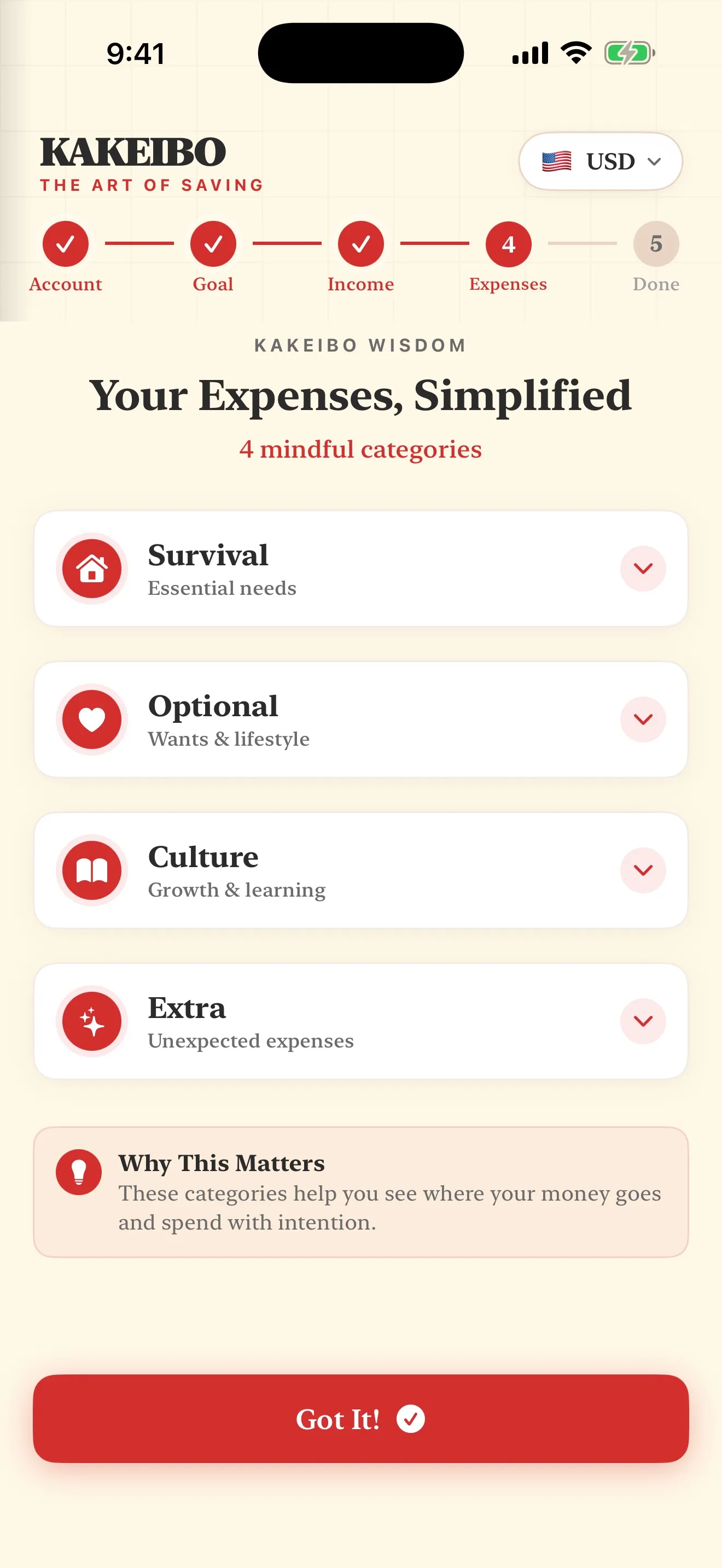
The categories on both sheets matter more than either sheet's layout. Most free sets use needs, wants and savings, which sounds sensible until an actual receipt tests it: a taxi home, a subscription, a birthday gift can each be argued into any of the three, so the category stops deciding anything. This method's four, Survival, Optional, Culture and Extra, ask a different question each rather than the same question at three levels of urgency, which is the full case made in the categories guide. The four category split calculator will sort your own numbers before you fill in a single sheet, so the plan you write starts from real proportions rather than a guess.
The review sheet is the one that actually earns the set its place. Ten minutes at the end of the month, reading the plan against the tracker in writing, is the step that turns two filled in pages into a decision about next month. Skip it and a beautifully designed set of sheets is functionally a diary nobody reads back.
What free actually costs you
Free, on most of the pages ranking for this search, means an email address rather than a payment. That is not automatically a bad trade: a newsletter in exchange for a PDF is an honest exchange if you know you are making it. What is worth knowing before you hand over the address is what usually comes with the sheet itself. Three patterns are common enough to check for on sight. The categories are often the generic needs, wants and savings split, which does the least useful sorting of any three category system in circulation. The file is often a flattened, uneditable PDF, so a category that does not fit your household cannot be renamed without printing over it by hand. And the set frequently stops at the tracker, with no review sheet at all, because a review sheet does not photograph well in the preview image that sells the download.
None of that makes a free set worthless. It means the price is not the thing to check first. Look at the preview image itself before you hand over an email address, and check for three things: categories that ask different questions rather than the same one three ways, a tracker with genuine room for real entries rather than four tiny boxes, and a review page, separate from the tracker, with room for sentences rather than ticks. A set that has all three is worth an email address. A set missing the third is a plan and a tracker with no ending.
How to do it well, with sheets you already have
You do not need to find the right free set to start today. Three plain sheets of paper, ruled by hand in about ten minutes, do the same job.
- Sheet one, the plan: income at the top, the savings line beneath it, then the four categories with an amount intended in each.
- Sheet two, the tracker: one row per entry, a date, an amount and a category, filled in as spending happens rather than reconstructed at the end of the week.
- Sheet three, the review: the four categories again, this time with planned and actual side by side, and a few lines underneath for the four questions in the reflection guide.
- Clip the three together and give them one fixed home, somewhere you already visit daily, not a drawer you have to remember to open.
- At the end of each week, total the tracker against the plan sheet and write the gap down. Small and non zero is normal; the gap is the information the set exists to produce.
- At month end, fill in the review sheet before starting next month's plan, so the review always happens before the planning rather than after it, which is the order most free sets get backwards by only offering a plan and a tracker.
The full mechanics of a single printed sheet, where it should live, what happens when a week goes badly, are covered in more depth in the printable budget pages guide, and if a bound, pre printed version appeals more than three loose sheets, the budget planner book guide covers what to check before buying one.
The free printable Christmas budget sheet, as its own case
Christmas is the one seasonal version of this search with real volume behind it, and it behaves differently enough to need its own sheet rather than the monthly plan reused with a different heading. A monthly budget sheet assumes recurring categories and a recurring income. A Christmas budget is a single lump total spent against a short list of names, over a few weeks rather than a calendar month, which makes the useful sheet a list, not a grid.
One sheet does the job: a total at the top, then a row for every person or obligation on the list, gift ideas, a planned amount and an actual amount next to each other, and a running total at the bottom that updates as each line is filled in. The category that matters here is not Survival, Optional, Culture or Extra, it is the running total against the number at the top, because the entire risk in a Christmas budget is the total quietly climbing past what was decided before the first gift was bought.
The better long term fix is not a sharper sheet in November, it is deciding the total months earlier and setting money aside for it as Extra, the envelope built for spending that happens once rather than monthly. A Christmas fund of a thousand dollars saved from March through to the start of December is a small, steady monthly figure rather than a lump the last two pay cheques of the year have to absorb, and 1,000 dollars over nine months shows what that looks like broken down. The save an amount in months calculator will do the same arithmetic on your own total and your own start date.
When a free sheet stops being enough
A printed sheet, free or otherwise, has the same three limits whoever designed it. It does not total itself, so an arithmetic slip early in the month compounds quietly until the review catches it, if the review happens. It cannot remind you, so a week with nothing written down produces a blank tracker rather than a nudge. And it is one physical object or one printed file, so a lost sheet is a lost month with no copy anywhere else.
None of that is a reason to skip paper. A weekly total catches the arithmetic before it compounds, a fixed home for the sheets solves the reminder problem, and a phone photo of each finished sheet before it goes back in the folder solves the lost sheet problem for the cost of thirty seconds. The point at which a free sheet genuinely stops being enough is when the household needs the totals done for it and available at the point of sale, which a printed page, however well designed, was never going to do. That is the honest case for an app, not a nicer looking sheet, and it is the only part of this comparison where we have a stake worth naming plainly: we publish a kakeibo app, and it holds the same plan, the same four categories and the same weekly totals, added up correctly every time.
We do not have a printable pack live yet either, and this guide would rather say that plainly than send you toward a download that goes nowhere. The templates page sets out exactly what ours will contain when it lands, ungated, no email address collected against a promise. Everything in this guide works on three plain sheets of paper in the meantime, and the same three categories, the same weekly total and the same monthly review sit behind the kakeibo method however you choose to hold them.
Common questions
- What should a free set of printable budget sheets actually include?
- At least three separate sheets doing three separate jobs: a monthly plan with income and honest categories decided before you spend, a tracking sheet where entries land as they happen, and a short review sheet at the end of the month that reads the two against each other. A single page trying to do all three usually runs out of room for the one that matters most, the review.
- Why do most free printable budget sheets ask for an email address first?
- Because the download is the product. A free sheet handed over for an email address is built to grow a mailing list, not to survive your month, which is a fine trade to make if you know you are making it. Nothing on this site is gated behind an email address, including the pack described on the templates page.
- Are free printable budget sheets as good as ones you pay for?
- The categories matter far more than the price. A free sheet with four honest categories that force a real decision beats a paid one built on a generic needs, wants and savings split, and plenty of the free sheets in circulation get the categories right. What free sheets skip more often is the review page, which costs nothing to add and is the one page doing the actual work.
- Is a free printable christmas budget sheet any different from a normal one?
- Only in one respect: it needs a list with a running total more than it needs monthly categories, because Christmas spending is one lump sum spread across a short list of names rather than a recurring month. Everything else, a place to record what you actually spent against what you planned, works the same way it does the rest of the year.
- Does the Kakeibo Method have free printable budget sheets?
- Not yet published. The pack is being drawn and will land ungated on the templates page, no email address and no watermark. Every sheet described in this guide, the plan, the tracker and the review, works on any ruled page in the meantime.
- What categories should free printable budget sheets use?
- Kakeibo's four, Survival, Optional, Culture and Extra, rather than needs, wants and savings. Survival asks what has to be paid, Optional asks what could be cut this week, Culture protects what you would genuinely regret losing, and Extra holds the spending that happens once rather than monthly. Each one answers a different question, which is why a receipt only ever fits in one of them.
Read nextThe whole library →
Where this one leads
You want one page on the wallPrintable budget pagesWhat a printed page has to do to survive a real month, and where in the house it has to live.8 min readYou are about to buy a bound plannerBudget planner booksWhat to check in the one photo of a monthly spread the shop shows you before a year rides on it.9 min readYou are holding a receipt that fits two envelopesThe four categoriesA working list of everyday expenses sorted into each envelope, with the awkward cases argued out rather than avoided.8 min read
A plan sheet, a tracker and a review. That is the whole set.
Free or paid, printed or ruled by hand, a working set of budget sheets does three separate jobs. Most free ones stop after two.
Get the Kakeibo app freeiPhone and iPad · Free tier, no account needed