Comparing methods
Kakeibo vs pay yourself first
Pay yourself first is one instruction: move the savings out before you can spend it. Kakeibo opens with the exact same instruction, then keeps asking what happened to everything that came after it. That second half is the whole of this comparison.
Pay yourself first is the most repeated instruction in personal finance, and it earns the repetition: decide an amount, move it out on payday before it can be spent on anything else, and treat what is left as the money you actually have to live on. Kakeibo agrees with every word of that. The kakeibo method calls the same move the savings promise, and it comes out first in exactly the same way, before a single category is planned or a single expense is sorted. The two are rarely put side by side because they look, at a glance, like the same advice wearing two names. They are, for one instruction. What happens after it is where they stop agreeing, and that is the part worth working through properly.
The instruction they both open with
Pay yourself first says the order matters more than the amount: savings first, spending second, never the other way round. Kakeibo's savings promise is the identical rule under a different name, and both exist to solve the same problem, which is that money left sitting in a current account at the end of the month gets spent by default, on nothing decided in advance. Automating the transfer on payday removes the decision entirely, which is the whole point of both methods and the reason either one beats simply intending to save what is left over.
If the comparison stopped here, there would be nothing to write. It does not stop here, because pay yourself first is a rule about one moment in the month and kakeibo is a rule about the other twenty nine days as well.
What the instruction stops saying, the moment the transfer clears
Pay yourself first has nothing built into it for after the transfer lands. The remainder is declared yours to spend, and the instruction treats spending it as a neutral act that needs no further attention: no categories, no distinction between the electricity bill and a night out, no scheduled point at which anyone checks whether the remainder actually held up against the month it just paid for. In an ordinary month, with no surprises in it, that silence costs nothing. The trouble is that the silence is exactly as present in the month that goes wrong as it is in the month that does not, and it is the wrong month where a plan is actually tested.
The month the remainder does not cover Survival
Take a household on 4,200 dollars a month take home. They set a savings promise of 500 dollars, moved out automatically on payday, leaving 3,700 dollars. In an ordinary month that comfortably covers Survival, rent, utilities, the minimum on any debt, and a baseline grocery bill, coming to around 2,900 dollars, with 800 dollars left for everything else. Pay yourself first looks, on paper, like a plan that works.
Then the car needs a 1,000 dollar repair. Nothing in the instruction has a place to put that. The household is left with three options, and all three are common. Pull the money back out of the account the transfer just built, which cancels the point of having paid themselves first at all. Put the repair on a card and let it become next month's problem instead of this month's. Or quietly skip a transfer, just this once, which is how most automated savings plans actually end: not in a single dramatic failure, but in a string of quiet exceptions that eventually outnumber the months the rule was followed. None of these are a failure of discipline. There was simply no envelope in the instruction built to hold an irregular cost, because the instruction was never asked to hold one.
Kakeibo runs the same transfer, then keeps a place for the rest
Kakeibo takes the identical first move, the promise moved out on payday, and then does the part pay yourself first stops short of: everything left over gets recorded as it is spent and sorted into one of four categories, set out in full in the four categories guide. Extra is the one built specifically for the shape of cost that broke the household above: large, irregular, and never due on a schedule. Sizing it properly, off Survival rather than off a guess, is worked through in the emergency fund guide, and the short version is that a household funding Extra every month has already set money aside for the car repair before it happens, rather than discovering the gap the day the bill arrives.
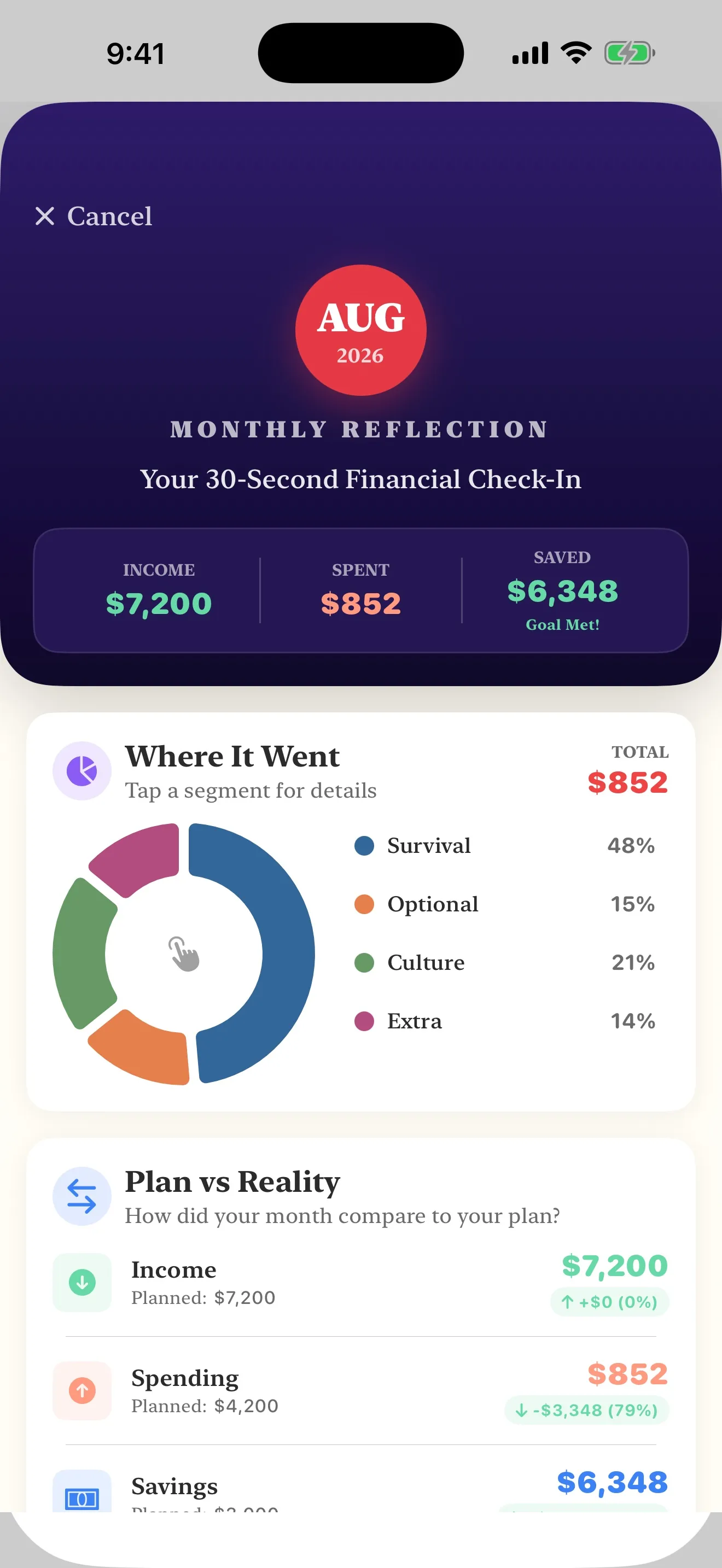
The other half of the difference is the monthly reflection. Once a month, kakeibo asks what actually came in, what actually went out, whether the two matched what was planned, and what should change. Pay yourself first has no equivalent question anywhere in it, because the instruction ends the moment the transfer clears and never checks back on the month it just funded.
The same household, run both ways
Run the 1,000 dollar repair through both plans on the same household. Under pay yourself first, the repair breaks the plan the month it lands, and nothing in the plan ever asks whether 500 dollars was the right amount to move in the first place, only whether the transfer cleared. Under kakeibo, the same 500 dollar promise still leaves on payday, and Extra is separately funded alongside it. Worked out in full on the 1,000 dollars in 6 months savings page, a fund built to cover exactly this size of shock comes to just under 167 dollars a month. By the time the car needs the repair, Extra has likely already been carrying several months of that figure, which means the bill is paid mostly or entirely from money that was already sitting there for this reason, without touching the automatic savings account at all. The monthly reflection would have shown Extra building for months before the repair, rather than the household finding out about the gap on the day the bill arrives.
Set the transfer, then run the four questions
- Automate the savings promise on payday, exactly as pay yourself first prescribes. Nothing about kakeibo changes this step.
- List the known irregular costs for a year and fund Extra monthly against that list, rather than leaving it to whatever is left over.
- Sort everything else into Survival, Optional and Culture as it is actually spent, not as it was guessed at in advance.
- Once a month, ask the four questions: what came in, what went out, whether the two matched, and what changes next month.
- Adjust the promise or Extra's funding from what the reflection actually shows, not from a percentage borrowed off the internet.
None of this asks a household to give up the one part of pay yourself first that genuinely works, which is the automatic transfer itself. It asks for one addition: a place to put what is left, and a monthly point at which somebody actually looks at it. The savings rate calculator and the kakeibo savings goal calculator both start from the same promise this comparison opens with, and the rest of the pairings kakeibo is worth comparing against are at the comparisons hub. Whichever a reader ends up running, the instruction underneath all of them agrees: the savings promise leaves first, or it does not leave at all.
Common questions
- Is kakeibo the same thing as pay yourself first?
- They open with the same instruction: decide the savings amount and move it out before anything else gets spent. Kakeibo calls this the savings promise and applies it exactly the way pay yourself first does. Where they part company is the rest of the month. Pay yourself first stops at the transfer. Kakeibo keeps recording and asks, once a month, what actually happened to what was left.
- What happens under pay yourself first when a bill is bigger than what is left?
- The instruction has no answer, because it was never asked to hold one. There is no envelope in it for a car repair or a vet bill, so the household either draws the savings back out of the account it just automated, puts the cost on a card, or quietly skips a transfer. All three are common, and none of them are failures of willpower. They are gaps in a plan that only ever covered the moment the transfer cleared.
- Do I have to stop the automatic transfer to do kakeibo?
- No. Keep it exactly as it is. Kakeibo does not replace pay yourself first, it runs the same automated promise and then adds the part the instruction leaves out: sorting what is left into Survival, Optional, Culture and Extra as it is actually spent, and checking the whole month against itself once it is over.
- Should the savings promise be a fixed percentage of income?
- No agency publishes a recommended figure worth borrowing, and this site will not invent one. Set the promise from your own take home pay and your own Survival costs, in the amount you can hold in a bad month as well as a good one, and let the monthly reflection tell you whether it needs to move.
- Which one should I actually run?
- Both, doing different jobs. Pay yourself first is the right instruction for the transfer itself: automatic, on payday, before anything else touches the money. Kakeibo is the right instruction for everything that happens afterward, which a single automated transfer was never built to watch.
Same first move. One of them keeps asking afterward.
Automate the transfer, exactly as pay yourself first says. Then give what is left a category and a monthly question, which is the half of the plan the instruction alone never covers.