
The method
What is kakeibo?
A household ledger, four spending categories, and four questions asked once a month. It is a hundred and twenty years old, it was written by a named journalist for a documented reason, and it is far more specific than the version that circulates online.
Kakeibo (家計簿) is simply the Japanese word for a household account book. In Japan it is a shelf in a stationery shop, not a philosophy: you buy one in December, it has the coming year printed in it, and you fill it in. In English the word has come to mean something narrower and more useful, which is the particular way of keeping that book set out by Hani Motoko in 1904.
That method has four moving parts. You record spending by hand, close to the moment it happens. You sort it into four categories rather than twenty. You decide what you are saving before you decide what you are spending. And at the end of the month you answer four written questions about what actually occurred. Everything else people attach to kakeibo, the cash envelopes, the pastel printables, the ratios, is either optional or invented.
Hani Motoko, and why the ledger existed
Hani Motoko (羽仁もと子, 1873 to 1957) was Japan's first female newspaper journalist, hired as a reporter at a time when the profession was closed to women. In 1903 she and her husband, Hani Yoshikazu, began publishing a household magazine, Katei no Tomo, which in 1908 was relaunched as Fujin no Tomo, the magazine still published today. The first printed kakeibo appeared in its pages in 1904, as a supplement its readers could fill in.
The reason it existed matters, and most English explainers skip it. In the Japan of 1904, married women typically ran the household budget in practice while having almost no legal or financial standing of their own. A written ledger turned that invisible work into a record: it made household spending arguable, plannable and defensible by the person actually doing it. Motoko was a reformist journalist and educator, and the ledger was a tool for financial agency, not a spiritual exercise.
It is worth being blunt about the framing this method usually receives in English. Kakeibo is not an ancient secret, it is not mystical, and there is nothing uniquely Japanese about writing down what you spent. It is a journalist's practical invention from the early twentieth century that happened to be very well designed, and it has been in continuous mainstream use in Japan ever since. Treating it as exotica is both inaccurate and, frankly, a bit rude to the woman who wrote it.
The English speaking wave is much more recent. Fumiko Chiba's book Kakeibo: The Japanese Art of Saving Money (Penguin Life, 2018) introduced the practice to a wide Western audience, and the current surge of interest rides on the same social media wave that made cash stuffing popular. That is also why so much of the English material is interchangeable: most of it is downstream of one book rather than of the original ledger.
The four questions
The method turns on four questions, asked in this order, once a month, in writing. The order is the mechanism.
- How much money do you have? Everything arriving this month, counted before anything is committed.
- How much would you like to save? Decided now, and moved out first, so that saving is not whatever survives the month.
- How much are you spending? Recorded as it happens, sorted into the four categories, by you.
- How can you improve? Answered at the end, in sentences, against the numbers rather than against a feeling.
Question two is where kakeibo differs structurally from most budgeting advice. Saving is not a residue. It leaves the account before the month begins, which converts overspending from a discovery into a decision. And question four is the part that no software can do for you, which is why the prompts for it are worth taking seriously: the four questions and monthly reflection prompts.
The four categories
Everything you spend goes into one of four envelopes. Translations vary between English editions, which is worth knowing before you argue with somebody about labels, but the split is consistent.
- Survival, the needs: housing, food, utilities, transport, insurance, medicine, minimum debt payments.
- Optional, the wants: eating out, subscriptions, alcohol, the shopping that is not replacing anything.
- Culture, the improving: books, courses, concerts, exhibitions, a membership you actually use.
- Extra, the irregular: car repairs, gifts, the vet, the excess on a claim, the thing that has not happened yet.
Two of those four are design decisions worth noticing. Culture is separated from Optional deliberately, so that the first thing cut in a tight month is not the thing that improves you. And Extra exists as a funded envelope rather than as an accident, because the repair and the wedding gift are the two costs that reliably push an otherwise sound month into debt.
Sorting real life into four boxes is less obvious than it looks, so we keep a working list of everyday expenses with the envelope each one goes in, and the reasoning for the awkward cases: the four kakeibo categories explained.
Try it on your own numbers
The rest of this page will make more sense against a real figure, so here is the method as an instrument. Put your monthly income in, decide what you would like to save, and enter the fixed costs you already know about. The four envelopes come out of what is left.
The method, on your income
Nothing you type there leaves your browser. If the Survival share came back higher than you expected, that is the most useful thing this page can tell you, and it is a housing and transport conversation rather than a discipline one.
What the public spending data says about the envelopes
National statistics offices publish where household money actually goes, and mapping their categories onto the four envelopes makes the method concrete. Two things stand out in every country that publishes this data: Survival dominates, and the discretionary envelope people worry about most is smaller than they think.
| Official category | Kakeibo envelope | Share of household spending |
|---|---|---|
| Housing (US) | Survival | About a third |
| Transport (US) | Survival | About a sixth |
| Food, at home and out (US) | Survival and Optional | About an eighth |
| Entertainment (US) | Optional and Culture | Under five percent |
| Housing, fuel and power (UK) | Survival | Roughly a sixth to a fifth |
Sources: United States Bureau of Labor Statistics, Consumer Expenditure Survey, 2024 release, which puts average annual household expenditure at roughly 78,500 dollars. United Kingdom Office for National Statistics, Family Spending. Shares are rounded, and the current year figures are published free by both offices, linked at the foot of this page.
Read that table as an argument for where to look first. If entertainment is under a twentieth of the average household budget, then a savings plan built entirely on cancelling it is a plan built on the smallest available lever. Housing and transport are two thirds of the picture in the American data, and they are exactly the costs the four envelope split labels Survival: fixed, slow to change, and therefore worth changing deliberately rather than never.
This is also the honest limit of any budgeting method, kakeibo included. A ledger cannot make an unaffordable rent affordable. What it can do is show you, within one month, which side of that line you are on.
Does kakeibo actually save you money?
Here is where we part company with most of the sites competing for this page. You will repeatedly read that kakeibo helps people save 20 to 35 percent more. We went looking for the primary source behind that figure and could not find one: no study, no survey, no publisher of the number that cites anything other than another blog. So we do not repeat it, and we would treat any site that does as a site that has not checked.
What can be said without inventing anything is narrower and more useful. Kakeibo makes spending visible at the moment it happens, it makes saving a prior commitment rather than a leftover, and it forces a written monthly review. Those three mechanisms are the reason people report that it works where automatic tracking apps did not. Whether that produces a big number for your household depends on your household, and one honest month is a cheaper way to find out than any statistic.
Paper or phone
The purist position is that kakeibo must be written by hand, because the friction is the feature. There is something to that: writing "42.60, lunch, Optional" engages you in a way that a bank feed categorising it overnight never will. The friction is doing the noticing, not the pen.
But paper has a failure mode, and it is the same one every time. The notebook is at home and the spending is not, so entries get reconstructed on Sunday from memory, and reconstructed entries are the part of the method that quietly stops being true. What actually matters is that the entry is made by you, close to the moment, with a category attached. A phone in your pocket satisfies all three conditions rather better than a notebook in a drawer.
The awkward modern case is cards, subscriptions and buy now pay later, where the money leaves at a different time from the decision. That is the single most common practical objection to a 1904 method and it deserves a proper answer rather than a shrug: how to do kakeibo with a credit card and digital payments.
How to start this month
- Write down your income for the month, everything, before anything is committed.
- Decide the savings promise and move it now. A standing transfer on payday is the entire trick. If you are working towards a specific number, the savings target calculator turns it into a monthly figure, and 294 common targets are already worked out.
- Record every expense for one month, with one of the four labels next to it. Do not tidy your spending while you do this. The first month is a measurement, not a performance.
- At month end, answer the four questions in writing.Then change exactly one thing.
One thing is not a modest ambition, it is the design. A month with four changes in it teaches you nothing about which one worked.
Common mistakes
- Saving what is left over. The promise comes out first or it does not come out at all.
- Leaving Extra empty. Then the first repair of the year comes out of the savings goal, and the plan feels like a failure when it was only unfunded.
- Making the first month a diet. Measure a normal month first. You cannot improve a number you have never seen.
- Sorting by merchant instead of by intent. A supermarket receipt can hold Survival, Optional and Culture in one transaction. The method wants your judgement, not the shop category.
- Skipping the reflection. Without it kakeibo is just bookkeeping with fewer columns, and bookkeeping alone changes nothing.
How it compares
If you want a target ratio rather than a monthly ritual, the 50/30/20 rule is the usual alternative, and it is genuinely easier to start: kakeibo versus the 50/30/20 rule, with a calculator that runs both on one income. If you are choosing between kakeibo, an app like YNAB, physical envelopes or cash stuffing, the comparison is here: kakeibo versus YNAB, envelopes and cash stuffing.
And if you would rather start with the arithmetic than with the reading, all 6 calculators are on one page.
Sources
- Hani Motoko (羽仁もと子), Japan's first female newspaper journalist, and the household magazine Katei no Tomo, later Fujin no Tomo (婦人之友), where the first printed kakeibo appeared in 1904.
- Fumiko Chiba, Kakeibo: The Japanese Art of Saving Money, Penguin Life, 2018, the book behind the English language revival.
- United States Bureau of Labor Statistics, Consumer Expenditure Surveys, for the American spending shares quoted above.
- United Kingdom Office for National Statistics, Family Spending, for the British figures.
Figures are quoted from the most recent releases available when this page was written and rounded deliberately. Both offices publish the current year free of charge, and where we could not verify a number, including the savings claim discussed above, we have left it out rather than repeated it.
Common questions
- What is kakeibo?
- Kakeibo (家計簿) is the Japanese word for a household account book, and in English it has come to mean a specific budgeting practice: you write your spending down by hand, sort it into four categories, decide your savings before you spend rather than after, and answer four questions about the month once it ends.
- How do you pronounce kakeibo?
- Roughly kah-keh-boh, three even syllables with no stressed one. The word is an ordinary Japanese noun rather than a brand, which is why you will find hundreds of unrelated kakeibo notebooks and apps sold under the same name.
- Who invented the kakeibo method?
- Hani Motoko, Japan's first female newspaper journalist, published it in 1904 in the household magazine she edited with her husband. It was written for women who ran household finances without any formal say over them, and giving those women a documented, defensible record was the explicit point.
- What are the four kakeibo categories?
- Survival, Optional, Culture and Extra in the usual English translation: needs, wants, self improvement, and the irregular costs like repairs and gifts. Four is few enough to sort at the counter, which is the moment the decision is actually made.
- What are the four kakeibo questions?
- How much money do you have? How much would you like to save? How much are you spending? How can you improve? They are asked in that order, once a month, and written down. The order matters: the savings promise is made before the spending is planned.
- Does kakeibo actually save you money?
- It makes spending visible while it is happening, which is a mechanism rather than a promise, and results vary by household. You will see a claim in this niche that kakeibo saves 20 to 35 percent; we could not find a primary source for it, so we do not repeat it. What we can say is that the method costs nothing to test for one month.
- Can you do kakeibo digitally?
- Yes, and the argument that it must be paper is weaker than it sounds. What matters is that the entry happens close to the moment of spending, by you rather than by an automatic feed. A phone in your hand at the till satisfies that better than a notebook left at home.
Four categories, four questions, one honest month
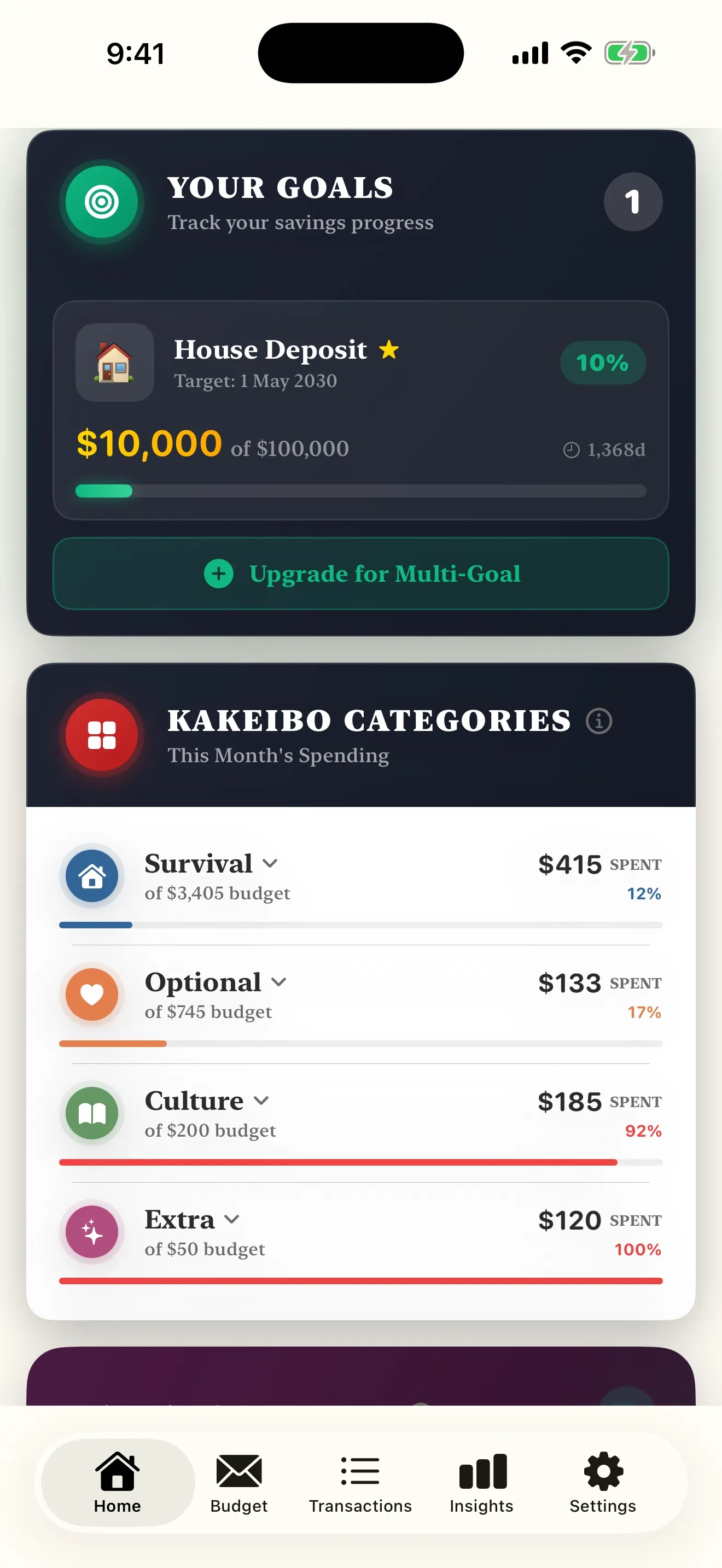
That is the whole method. The app keeps the ledger between reflections, with the same four envelopes and the questions built in, so the only work left is the noticing.